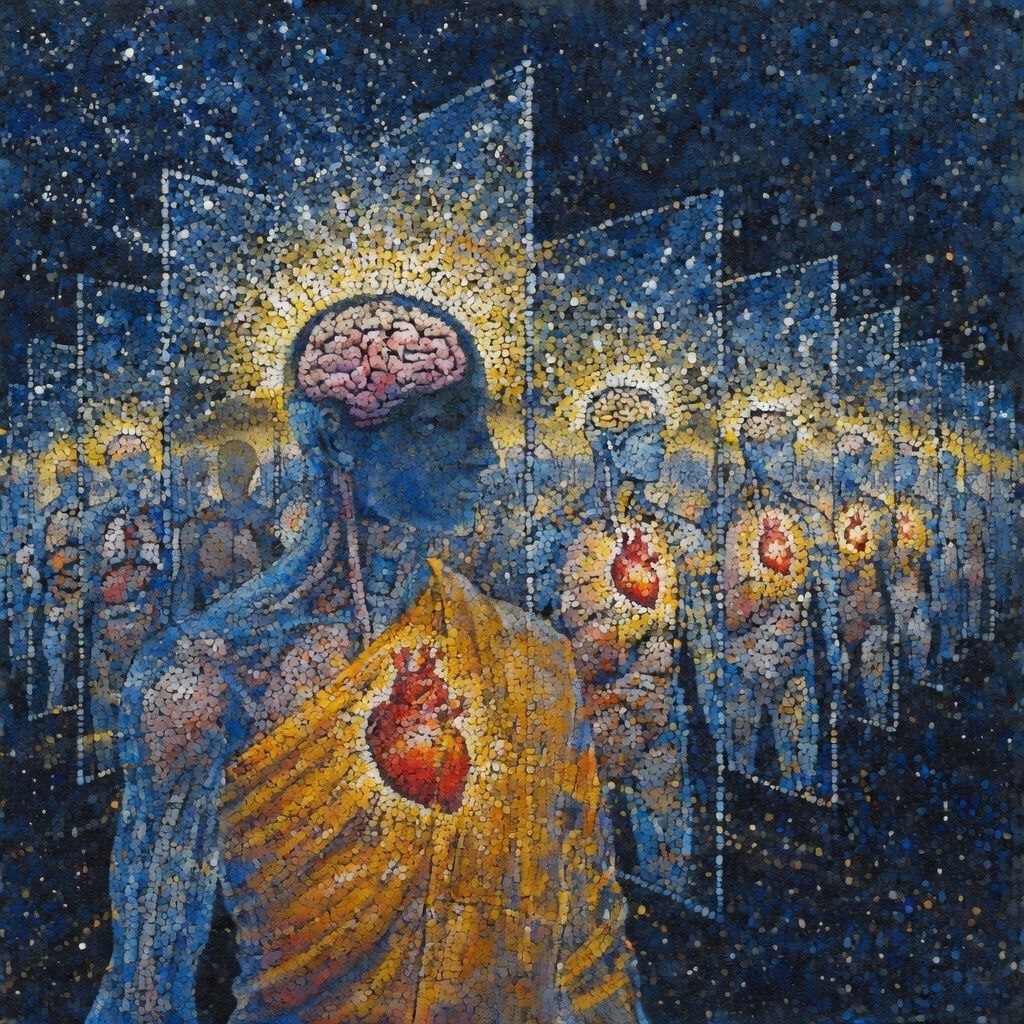
How can one schematically envision the complete, ultimate picture of reality "from the outside," as it is set forth in the Teaching of the Buddhas, and as it is seen directly through the practice of insight (vipassanā)?
There are two kinds of phenomena (dhammā): conceptual and ultimate. Ultimate phenomena are the various kinds of mentality and materiality. Ultimate phenomena are those that are taken by consciousness (the pure mind-door, free from the admixture of sense-doors) directly and disclosed as a given without mental construction. Conceptual phenomena are the product of mental construction.
Thus, all phenomena of mentality and materiality constitute a discrete stream of "flashes." Consciousness and matter are discrete, non-linear, and represent momentary phenomena that contain within themselves three stages: arising, presence, and dissolution. The stage of presence of material phenomena lasts longer than that of immaterial ones. In the time of a finger-snap, myriads of moments of mentality and materiality arise and pass away, but the mind's habitual tendency to "economize" on perception glues this swarm of selfless phenomena into self-laden concepts.
So let us take an abstract, pure present moment and attempt to roughly sketch the picture of which phenomena of ultimate reality are present within it.
Let us begin with materiality (rūpa). First, there is the "body," but in essence it is the four material great elements (mahābhūta). The earth element (paṭhavī-dhātu) is the aspect of impenetrability or hardness — that which one can "bump into." The water element (āpo-dhātu) is the aspect of cohesion [of the earth element]. The fire element (tejo-dhātu) is the aspect of the production of the remaining great elements (from temperature, i.e. from combination with the external fire element, from kamma, from nutriment, or from consciousness). The wind element (vāyo-dhātu) is the aspect whereby all great elements are capable of being produced by the fire element in adjacent locations — that is, nearby — which provides the principle of "movement." The material great elements arise and cease all together; none arises separately. However, within one group of great elements there can be varying prominence of one or another great element, which causes matter to change its properties: becoming harder when the earth element is prominent, more liquid-like when the water element is prominent, more unstable (up to the degree of plasma) when the fire element is prominent (new groups of elements are produced too rapidly for a moment of static stability to occur — matter does not "cool down"), and more "swift" when the wind element is prominent.
Next, there are the material bases upon which various types of consciousness arise: the bases of the eye, ear, nose, tongue, body, and mind (the last being, in general terms, a specific kind of matter in the heart, but also in the brain — the nuances of which will not be examined here). Then, there are the object-types of materiality for sense-consciousness: the visible (rūpārammaṇa), sound (saddārammaṇa), smell (gandhārammaṇa), taste (rasārammaṇa). (The objects of body-consciousness are the earth element as hardness/softness, the wind element as tactile pressure, and the fire element as low/high temperature; the water element is not cognized through the body, only through the mind-door.)
Further, there are the material phenomena of nutritive essence (food), life, and sex (masculine/feminine). In total there are 28 kinds of material phenomena, but some among them are conceptual, and therefore the number of ultimate kinds of materiality is smaller.
Next, there are the various kinds of consciousness. At any one moment in time, only one moment-flash of consciousness can be present. They succeed one another with tremendous speed, but we shall set this aside and represent them here as a static group (which does not happen in reality). Accordingly, there are consciousnesses of the eye, ear, nose, body, and tongue, and then various kinds of consciousnesses belonging to the pure mind-door process, which arise either as a continuation of a sense-door process or independently (we shall not go into all the details of this). Among the consciousnesses of the pure mind-door, there are wholesome ones (seeing the given-ness of a phenomenon without proliferation into it), and those associated with craving, aversion, and pure delusion (i.e. anxiety and doubt). The types of consciousness, depending on the classification, number 89 or 121.
All consciousnesses co-arise and co-cease together with cetasikā — mental factors; this is like a king and his retinue — the king never goes alone. Among the universal cetasikā (those that arise with every type of consciousness) are: feeling, perception, contact, one-pointedness, attention, and so on. Those arising with wholesome types of consciousness include: mindfulness, rectitude, lightness, pliancy, wieldiness, and so on. Those arising with unwholesome types of consciousness include: greed, conceit, aversion, views, delusion, and so on. In total there are 52 mental factors.
Such, then, is one "cross-section" of the phenomena of ultimate reality. All of them arise by way of 24 conditions. We have confined our description of dhammā to the framework of a single process of mentality-materiality, or one "body," as if describing it within a "sphere." This sphere is, in essence, what the observing consciousness itself knows. However, with the development of the power of insight, this sphere can be expanded, and it will come to include the inanimate material elements of earth and so on surrounding the living "body," as well as the materiality and mentality of other beings. In sum, we can expand this sphere to the scale of an entire world-system, encompassing beings of the three planes and other inanimate matter. Of course, such a scale of knowledge requires the development of certain qualities of consciousness.
However, all of this is merely one cross-section of "the universe" at one moment in time — an abstract "now." Exactly the same cross-sections have existed infinitely into the past, and at each cross-section the configuration of the phenomena of mentality and materiality was different.
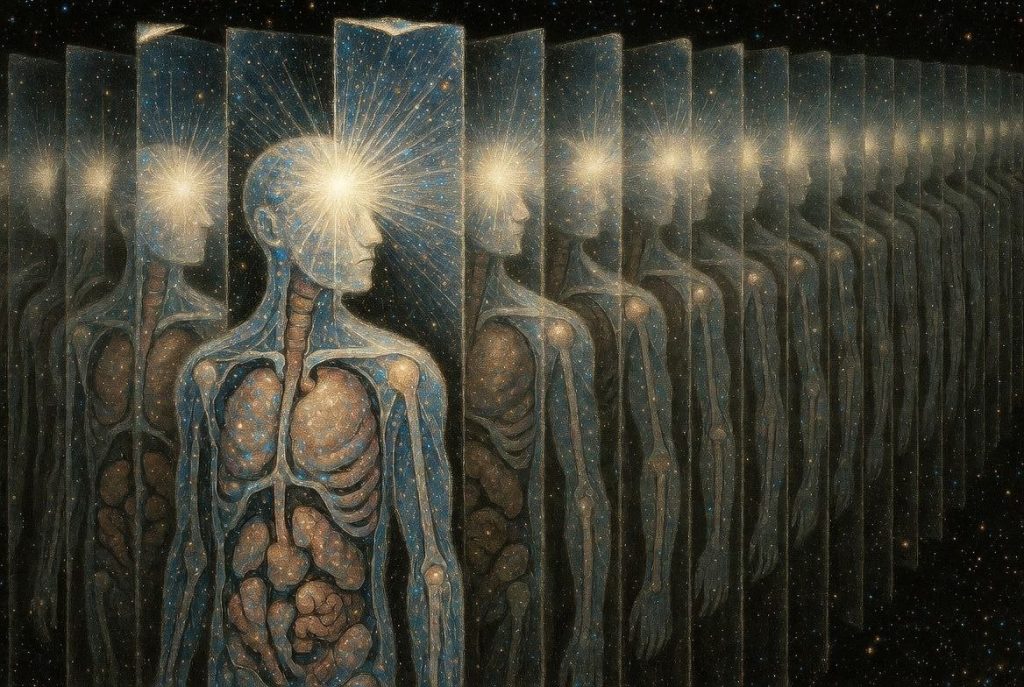
The point is that the mind is in principle capable of leaping across these past cross-sections and seeing there each phenomenon of mentality and materiality. How far and how clearly into the past and into the breadth depends solely on the qualities of wisdom, mindfulness, and concentration of the observing consciousness. All these phenomena in the past are still just as real (they do not become concepts), but simply no longer present (their moment of presence has passed and a new "cross-section" has come), and in them the characteristics of impermanence and so on can still be seen — even two kappas ago and 500 light-years from the observer, at a point where their process of mentality-materiality was not located at that time. That is to say, the mind in principle sees in so-called "four dimensions"; the scope and clarity of seeing depend only on the strength and training of consciousness. Only because such a principle exists is the practice of insight (vipassanā) possible at all. And even certain future "cross-sections" of dhammā that have yet to occur can be seen directly in advance, though this is an optional kind of seeing. The images appended to this article are intended to very schematically visualize what has been described above.
Everything enumerated above is taken as object directly and immediately through the pure mind-door process, disconnected from the sense-doors (yes, even sound or the visible can be cognized through mind alone without direct contact with the corresponding sense-doors, but that, again, is a separate topic).
So then, what is to be done? To take these phenomena directly with the mind, to see in them the three characteristics. Optionally: to attain the states of absorption (jhāna) and to examine those as well. Impermanence — any listed phenomenon of nāma or rūpa contains within itself the sub-moments of arising, presence, and dissolution; discerning them yields knowledge of the impermanence of the phenomenon IN ITSELF — that it is unstable and decaying within its own bounds. Suffering — because of dissolution (and phenomena arise and dissolve with tremendous speed, myriads within a second), all phenomena are marked by the oppression of dissolution — they cannot become a safe haven. Non-self — in no phenomenon of ultimate reality is there an aspect of a self-core — these are merely empty phenomena, arising "on a surface" and "in the air" — without any pre-arising or co-arising of a self-core; the self is merely a conceptual product that emerges from the non-discernment of ultimate reality — an economy of knowledge — delusion (moha, avijjā). Seeing thus again and again, the mind at a certain point turns away toward the phenomenon of Cessation (Nibbāna), taking it as object, thereby entering the stream (sotāpatti). Do so four times, each time with ever stronger qualities of mind that see Cessation ever more powerfully, and all defilements will be eliminated. Without them, new birth is impossible. The oppression by dissolution (in other words saṅkhāra-dukkha — the suffering of the conditioned) ceases once and for all.
In the overall picture, all of this appears as something inconceivable, yet it all begins with seeing simple and understandable phenomena of ultimate reality, and, thread by thread, this tangle is unraveled through direct realization. The methods of practice are a topic for another time and place.
 EN
EN  RU
RU