Venerable Gnanaseeha Rakwane Thero
Download the book in electronic format: PDF, EPUB
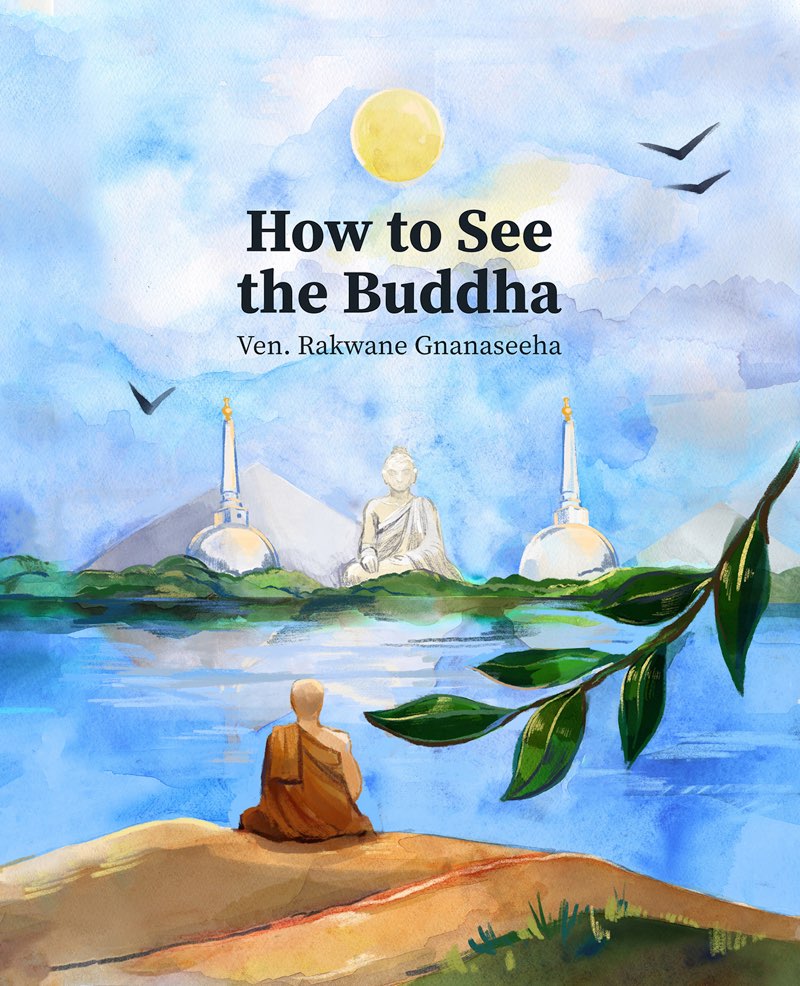
Namo tassa bhagavato arahato sammāsambuddhassa!
Namo tassa bhagavato arahato sammāsambuddhassa!
Namo tassa bhagavato arahato sammāsambuddhassa!
Homage to the Blessed One, the Worthy One, the Perfectly Enlightened One
Homage to the Blessed One, the Worthy One, the Perfectly Enlightened One
Homage to the Blessed One, the Worthy One, the Perfectly Enlightened One
About the Book
This is the third book by Bhante Gnanaseeha, intended for a wide audience. Unlike his previous book, Bhāvanā — The Art of the Mind, which brought together several of Bhante’s discourses on various aspects of Buddhist practice, this book consists of a single discourse — on the qualities of the Buddha. However, the greater part of this book comprises passages from the suttas of the Pāli Canon, which we have added alongside Bhante Gnanaseeha’s commentary.
The choice of subject was not made without reason. Without knowing the Buddha — without holding right view with regard to him — one cannot fully walk the Noble Eightfold Path. This is a matter of principle. The Buddha is the source of all our knowledge of the Dhamma. The figure of Buddha Sākyamuni Gotama unites all traditions of Buddhism; everything began with the Buddha. And in order to understand who the Buddha is, one must come to know his qualities.
One who sees the Dhamma sees me; one who sees me sees the Dhamma. For in seeing the Dhamma, Vakkali, one sees me; and in seeing me, one sees the Dhamma.
Vakkalisutta: Vakkali (SN 22.87), translation by Ven. Bhikkhu Bodhi
The recollection of the Buddha is not merely a support or a «preliminary tuning» for further practice — it is the foundation of our right view, right attitude, and right intention.
The Tathāgata (the Buddha) recommended the practice of recollecting the qualities of the Buddha, the Dhamma, and the Sangha to both monastics and lay followers alike. It can serve as an inexhaustible source of wholesome qualities, a protection from fear, and a refuge in the ocean of saṃsāra. It is not without reason that the ritual of becoming a Buddhist is called the Taking of Refuge — we take Refuge in the Three Jewels: the Buddha, the Dhamma, and the Sangha. And for this, we must understand what these truly are.
But, bhikkhus, I say this: If you have gone to a forest or to the foot of a tree or to an empty hut, and fear or trepidation or terror should arise in you, on that occasion you should recollect me thus: “The Blessed One is an arahant, perfectly enlightened, accomplished in true knowledge and conduct, fortunate, knower of the world, unsurpassed leader of persons to be tamed, teacher of devas and humans, the Enlightened One, the Blessed One.” For when you recollect me, bhikkhus, whatever fear or trepidation or terror you may have will be abandoned.
Dhajaggasutta: The Crest of the Standard (SN 11.3),
translation by Ven. Bhikkhu Bodhi
Respect, veneration, and having a reliable basis for one’s practice of the Noble Eightfold Path are of such importance that even the Buddha himself, following his enlightenment, sought someone whom he could respect and venerate, and upon whom he could rely as he lived. Finding no one more perfect in knowledge and vision of liberation, no one superior to himself, the Buddha resolved to honour and respect the very Dhamma he had fully penetrated, submitting himself to that same Dhamma. It is said that all the Buddhas of the past, following their enlightenment, undertook the same search and arrived at the same resolve. We, in turn, must respect and venerate the Buddha, and live with him as our foundation.
By carefully studying the qualities of the Buddha, one comes to understand that he is our foremost good friend. He is in no way a judge over us. The Buddha punished no one, held aversion toward no one, and harboured craving for nothing.
The Buddha wished only welfare for living beings, and gave his entire Teaching out of boundless compassion for us, for the benefit of all sentient beings. This is his greatest gift to us. But whether we accept this gift, and what we make of it, depends entirely upon ourselves. The Buddha showed us the Path, yet it is we who must walk it. The Buddha punished no one for declining to walk this Path. And so the responsibility is wholly ours.
For this, we need to cultivate the quality of reasoned faith (ākāravant saddhā). We must understand in whom and in what we place our faith — only then will our faith and our practice rest upon a firm foundation.
Blind faith (amūlika saddhā) is not encouraged in the Teaching of the Nobles. We must understand that our faith is, among other things, the fruit of our practice in past lives. This very openness to the Teaching, this trust in the Buddha, this readiness to lend an ear to the Dhamma — these are fruits of our past practice as well. Our task is to develop and root these qualities firmly, so that we may not pass the Teaching by in lives yet to come.
And what, bhikkhus, is the power of faith? Here, a noble disciple is endowed with faith. He places faith in the enlightenment of the Tathāgata thus: “The Blessed One is an arahant, perfectly enlightened, accomplished in true knowledge and conduct, fortunate, knower of the world, unsurpassed trainer of persons to be tamed, teacher of devas and humans, the Enlightened One, the Blessed One.” This is called the power of faith.
Vitthatasutta: In Detail (AN 5.14), translation by Ven. Bhikkhu Bodhi
This book is a gift of Dhamma and is intended for free distribution for the benefit of all living beings. When reproducing any material, please include references to the website samatha-vipassana.com. The digital edition of this and Bhante’s previous books, as well as other discourses of his not yet published in book form, are available on the official website of Chittaviveka Monastery: samatha-vipassana.com/en/books.
May this knowledge become a source of support, strength, and kindness for you, and may it help you find freedom from all suffering!
Maksim Suleymanov
So I have heard. At one time, when he was first awakened, the Buddha was staying in Uruvelā at the root of the goatherd’s banyan tree on the bank of the Nerañjarā River.
Then as he was in private retreat this thought came to his mind, “One without respect and reverence lives in suffering. What ascetic or brahmin should I honor and respect and rely on?”
Then it occurred to him:
“I’d honor and respect and rely on another ascetic or brahmin so as to complete the entire spectrum of ethics, if it were incomplete. But I don’t see any other ascetic or brahmin in this world—with its gods, Māras, and Divinities, this population with its ascetics and brahmins, its gods and humans—who is more accomplished than myself in ethics, who I should honor and respect and rely on.
I’d honor and respect and rely on another ascetic or brahmin so as to complete the entire spectrum of immersion, if it were incomplete. But I don’t see any other ascetic or brahmin … who is more accomplished than myself in immersion …
I’d honor and respect and rely on another ascetic or brahmin so as to complete the entire spectrum of wisdom, if it were incomplete. But I don’t see any other ascetic or brahmin … who is more accomplished than myself in wisdom …
I’d honor and respect and rely on another ascetic or brahmin so as to complete the entire spectrum of freedom, if it were incomplete. But I don’t see any other ascetic or brahmin … who is more accomplished than myself in freedom …
I’d honor and respect and rely on another ascetic or brahmin so as to complete the entire spectrum of the knowledge and vision of freedom, if it were incomplete. But I don’t see any other ascetic or brahmin in this world—with its gods, Māras, and Divinities, this population with its ascetics and brahmins, its gods and humans—who is more accomplished than myself in the knowledge and vision of freedom, who I should honor and respect and rely on. Why don’t I honor and respect and rely on the same Dhamma to which I was awakened?”
Then the divinity Sahampati knew what the Buddha was thinking. As easily as a strong person would extend or contract their arm, he vanished from the realm of divinity and reappeared in front of the Buddha. He arranged his robe over one shoulder, raised his joined palms toward the Buddha, and said:
“That’s so true, Blessed One! That’s so true, Holy One! All the perfected ones, the fully awakened Buddhas who lived in the past honored and respected and relied on this same teaching. All the perfected ones, the fully awakened Buddhas who will live in the future will honor and respect and rely on this same teaching. May the Blessed One, who is the perfected one, the fully awakened Buddha at present, also honor and respect and rely on this same teaching.”
This is what the divinity Sahampati said. Then he went on to say:
“All Buddhas in the past,
the Buddhas of the future,
and the Buddha at present—
destroyer of the sorrows of many—
respecting the true teaching
they did live, they do live,
and they also will live.
This is the nature of the Buddhas.
Therefore someone who desires self-knowledge,
and aspires to greatness themselves,
should respect the true teaching,
remembering the instructions of the Buddhas.”
Gāravasutta: Respect (SN 6.2), translation by Ven. Bhikkhu Sujato
Introduction
At vandanās (vandanā — a religious ceremony of paying respect) and other such gatherings, monastics and laypeople most commonly recite one of three suttas — the Karaṇīyamettā, the Maṅgala, or the Ratana Sutta — as well as various verses for recollection.
Whatever suttas or recitations are used — such as, for example, the recollections of the Buddha, the Dhamma, and the Sangha — they always contain within them the full depth of the Teaching: in some suttas expressed in condensed form, in others in greater detail.
When a vandanā or pūjā (an offering of food, flowers, incense, and so forth) is performed, it functions as a practice of recollection — sati. As a result of such brief recollection, the mind becomes preliminarily attuned to a wholesome action, such as offering food or engaging in bhāvanā practice.
There are many verses for recollection.
We use them, for instance, to enliven the mind — to make it joyful and calm. For when the mind is joyful and calm, one can practise Buddhist meditation effectively. We recollect the qualities of the Buddha, the Dhamma, and the Sangha. We recollect our own generosity, our virtue, our wholesome deeds, and the wholesome fruit they bring. We recollect the devas, and the fact that their birth in the divine realms was the result of their generosity, virtue, and the cultivation of beneficial qualities of mind. The mindful recitation of these verses, with an understanding of their meaning, can swiftly fill the mind with wholesome qualities.
At the beginning of a vandanā, and indeed of any other gathering, we always recite three times: «Namo tassa bhagavato arahato sammāsambuddhassa.»
Homage to the Blessed One, the Worthy One, the Perfectly Enlightened One.
At this moment we recollect, because we know the meaning of these verses.
We honour him as Bhagavā — the most revered in the Three Worlds (and we know why he is the most revered in the Three Worlds). We honour him as Arahant, knowing that the Arahant has uprooted all defilements entirely. We honour him as Sammāsambuddha — the Perfectly Self-Enlightened One — and we know that to attain this he perfected wholesome qualities over an inconceivably vast span of time: qualities such as generosity, renunciation, goodwill, honesty, and determination. We know that there can be no being with more fully developed wholesome qualities than the Buddha.
When we perform these ceremonies of vandanā and pūjā, or mindfully recite recollection texts, wholesome consciousnesses arise in the mind predominantly. These can serve as a support and as a condition for the arising of subsequent wholesome consciousnesses — in this way the mind becomes more joyful and calm, and we can move into deeper practices with far greater ease. It is also an excellent means of shifting from an unwholesome stream of consciousnesses (citta vīthi) to a wholesome one in the course of daily life.
A mind properly attuned before any wholesome action — whether an act of generosity or a meditation practice — is one of the conditions for that wholesome action to yield the most fruitful results (it is one of the conditions for the performance of the highest wholesome kamma). For example, before making a food offering to a monk, a person goes to the shop to buy ingredients for preparing the dāna, prepares the food with their own hands, and makes their way to the place of meeting with the monk — and throughout all of this they are glad of it; they know what such wholesome actions lead to, they recollect this, and recollect that it will serve as a support on their path to Nibbāna. Such is the preliminary intention (purimā cetanā) that precedes the act of giving. With that same joyful and mindful state of mind they offer the food to the monk — and this is the intention of releasing (muñcanā cetanā). After the giving, they remain glad of it for a long time and reflect at length upon the act of generosity they have performed — and this is the subsequent intention (aparā cetanā). When these three stages of volition are present in any wholesome deed, this is one of the conditions for the highest wholesome kamma — which may even become a condition for rebirth in higher realms, or a powerful support for the attainment of Nibbāna.
With all of this in mind, it is easy to appreciate the significance of the recollection practice — including the recollection of the qualities of the Buddha. For instance, one can mindfully and reflectively recite the verses before sitting down to meditate. After meditation, rather than immediately turning the mind to ordinary matters, one should bear in mind that the subsequent intention (aparā cetanā) is equally important following any wholesome action — in this case, meditation. It is important to call such actions to mind, to gladden the mind with them, and to understand where they lead.
The practice of recollecting the qualities of the Sammāsambuddha — described in detail throughout this book — can be not merely a swift preliminary preparation of the mind, but a principal practice in its own right, leading to a deep pre-jhāna tranquillity of mind. The Buddha recommended such practice to both monastics and lay followers alike. These practices are described most thoroughly in Buddhaghosa’s treatise, the Visuddhimagga.
Bhikkhu Asankhata Russiave
And how does a religious donation have six factors? Three factors apply to the donor and three to the recipients.
What three factors apply to the donor? It’s when a donor is in a good mood before giving, while giving they feel confident, and after giving they’re uplifted. These three factors apply to the donor.
What three factors apply to the recipients? It’s when the recipients are free of greed, hate, and delusion, or practicing to be free of them. These three factors apply to the recipients.
Thus three factors apply to the donor and three to the recipients. That’s how a religious donation has six factors.
It’s not easy to grasp the merit of such a six-factored donation by saying that this is the extent of their overflowing merit, overflowing goodness that nurtures happiness and is conducive to heaven, ripening in happiness and leading to heaven. And it leads to what is likable, desirable, agreeable, to welfare and happiness. It’s simply reckoned as an incalculable, immeasurable, great mass of merit.
It’s like trying to grasp how much water is in the ocean. It’s not easy to say how many gallons, how many hundreds, thousands, hundreds of thousands of gallons there are. It’s simply reckoned as an incalculable, immeasurable, great mass of water. In the same way, it’s not easy to grasp the merit of such a six-factored donation …
A good mood before giving,
confidence while giving,
feeling uplifted after giving:
this is the perfect sacrifice.
Free of greed, free of hate,
free of delusion, undefiled;
this is the field for the perfect sacrifice,
the disciplined spiritual practitioners.
After rinsing,
you give with your own hands.
This sacrifice is very fruitful
for both yourself and others.
When an intelligent, faithful person,
sacrifices like this, with a mind of letting go,
that astute one is reborn
in a happy, pleasing world.”
Chaḷaṅgadānasutta: A Gift With Six Factors (AN 6.37),
translation by Ven. Bhikkhu Sujato
Remembrance of the Qualities of the Three Jewels
Qualities of the Buddha
Itipi so bhagavā arahaṃ sammāsambuddho
Truly the Blessed One, the Worthy One, fully awakened
Vijjācaraṇasampanno sugato lokavidū
Endowed with knowledge and conduct, rightly gone, knower of the worlds
Anuttaro purisadammasārathi
Unsurpassed charioteer of those who can be tamed
Satthā devamanussānaṃ buddho bhagavāti
Teacher of gods and humans, awakened, blessed one
Buddhaṃ jīvitaṃ yāva-nibbānaṃ saraṇaṃ gacchāmi.
To the Buddha I go for the refuge for life until full cessation (nibbāna).
Qualities of the Dhamma
Svākkhāto bhagavatā dhammo
Well-expounded is the Dhamma by the Blessed One
Sandiṭṭhiko akāliko ehipassiko
Directly visible, whose fruit is not delayed, inviting one to come and see
Opanayiko paccattaṃ veditabbo viññūhīti
Leading to the goal, to be experienced individually by the wise.
Dhammaṃ jīvitaṃ yāva-nibbānaṃ saraṇaṃ gacchāmi.
To the Dhamma I go for the refuge for life until full cessation (nibbāna).
Qualities of the Saṅgha
Supaṭipanno bhagavato sāvakasaṅgho
Practiced well is the Saṅgha of the Blessed One’s disciples
Ujupaṭipanno bhagavato sāvakasaṅgho
Practiced straight is the Saṅgha of the Blessed One’s disciples
Ñāyapaṭipanno bhagavato sāvakasaṅgho
Practiced rightly is the Saṅgha of the Blessed One’s disciples
Sāmīcipaṭipanno bhagavato sāvakasaṅgho
Practiced properly is the Saṅgha of the Blessed One’s disciples
Yadidaṃ cattāri purisayugāni aṭṭha purisapuggalā
Namely, four pairs and eight kinds of persons
Esa bhagavato sāvakasaṅgho
This is the Saṅgha of the Blessed One’s disciples
Āhuṇeyyo pāhuṇeyyo dakkhiṇeyyo añjalikaraṇīyo
Worthy of offerings, hospitality, gifts, respectful salutation
Anuttaraṃ puññakkhettaṃ lokassati
The unsurpassed field of merit for the world
Saṅghaṃ jīvitaṃ yāva-nibbānaṃ saraṇaṃ gacchāmi.
To the Saṅgha I go for the refuge for life until full cessation (nibbāna).
Sermon
Today I would like to speak to you about the Buddha and the qualities of the Buddha.
The Buddha is our Teacher. The Buddha is our example. The Buddha is our hero. He is our support on the spiritual path. We need to know about the Buddha in order to be able to progress along this Noble Eightfold Path. Why? Because the Buddha says: saddhā (faith, trust, confidence, devotion) is bīja — a seed. Everything begins with it (saddhābīja). And for right saddhā to arise in a person, they must come to know the Buddha.
Faith is my seed, fervor my rain,
and wisdom is my yoke and plough.
Conscience is my draft-pole, mind my strap,
mindfulness my plowshare and goad.
Kasibhāradvājasutta: With Bhāradvāja the Farmer (Snp 1.4),
translation by Ven. Bhikkhu Sujato
“Mendicants, there are these four kinds of overflowing merit, overflowing goodness that nurture happiness. What four? It’s when a noble disciple has experiential confidence in the Buddha … the teaching … the Saṅgha …
Furthermore, a noble disciple is wise. They have the wisdom of arising and passing away which is noble, penetrative, and leads to the complete ending of suffering. This is the fourth kind of overflowing merit, overflowing goodness that nurtures happiness. These are the four kinds of overflowing merit, overflowing goodness that nurture happiness.
When a noble disciple has these four kinds of overflowing merit and goodness, it’s not easy to measure how much merit they have by saying that this is the extent of their overflowing merit, overflowing goodness that nurtures happiness. It’s simply reckoned as an incalculable, immeasurable, great mass of merit.”
That is what the Buddha said. Then the Holy One, the Teacher, went on to say:
“One who desires merit, grounded in the skillful,
develops the path to realize freedom from death.
Once they’ve reached the heart of the teaching,
delighting in ending,
they don’t tremble at the approach
of the King of Death.”
Tatiyaabhisandasutta: Overflowing Merit (3rd), SN 55.43,
translation by Ven. Bhikkhu Sujato
The Buddha can be described through nine qualities. The Buddha can only be understood through his qualities — there is no other way to understand him.
Sometimes people say that during meditation they saw the Buddha, that he spoke with them or gave them his blessing. But that is not the Buddha. Such people do not understand the Buddha. The Buddha can only be understood through his qualities — the Buddha himself said: «One who sees the Dhamma sees me, and one who sees me sees the Dhamma.»
“Mendicants, suppose a mendicant were to hold the corner of my cloak and follow behind me step by step. Yet they covet sensual pleasures; they’re infatuated, full of ill will and malicious intent. They are unmindful, lacking situational awareness and immersion, with straying minds and undisciplined faculties. Then they are far from me, and I from them. Why is that? Because that mendicant does not see the teaching. Not seeing the teaching, they do not see me.
Suppose a mendicant were to live a hundred leagues away. Yet they do not covet sensual pleasures; they’re not infatuated, or full of ill will and malicious intent. They have established mindfulness, situational awareness and immersion, with unified mind and restrained faculties. Then they are close to me, and I to them. Why is that? Because that mendicant sees the teaching. Seeing the teaching, they see me.”
Saṅghāṭikaṇṇasutta: The Corner of the Cloak (Iti 92),
translation by Ven. Bhikkhu Sujato
In order to understand the Buddha, let us examine his qualities in some detail.
The quality of arahaṃ
The first quality is arahaṃ. This means that in the mind of the Buddha there are no defilements whatsoever. One might say that the Buddha was the purest person who ever existed in this world, the purest being of all. Even arahants cannot compare with the Buddha. Such is the quality of arahaṃ.
After attaining enlightenment, the Buddha set out toward the five ascetics with whom he had practised prior to his enlightenment, and along the way he encountered a man by the name of Upaka. Upaka beheld the radiance of the Buddha.
Between Gayā and the Place of Enlightenment the Ājīvaka Upaka saw me on the road and said: “Friend, your faculties are clear, the colour of your skin is pure and bright. Under whom have you gone forth, friend? Who is your teacher? Whose Dhamma do you profess?” I replied to the Ājīvaka Upaka in stanzas:
“I am one who has transcended all, a knower of all,
Unsullied among all things, renouncing all,
By craving’s ceasing freed. Having known this all
For myself, to whom should I point as teacher?
I have no teacher, and one like me
Exists nowhere in all the world
With all its gods, because I have
No person for my counterpart.
I am the Accomplished One in the world,
I am the Teacher Supreme.
I alone am a Fully Enlightened One
Whose fires are quenched and extinguished.
I go now to the city of Kāsi
To set in motion the Wheel of Dhamma.
In a world that has become blind
I go to beat the drum of the Deathless.”
“By your claims, friend, you ought to be the Universal Victor.”
“The victors are those like me
Who have won to destruction of taints.
I have vanquished all evil states,
Therefore, Upaka, I am a victor.”
Pāsarāsisutta: The Noble Search (MN 26), translation by Ven. Bhikkhu Bodhi
All human beings, devas, and brahmās — all unenlightened beings — possess lōbha (greed), dōsa (ill will), and mōha (delusion). The Incomparable One has none of these, and it is for this reason that he may be called the Buddha.
On one occasion the Blessed One was traveling along the highway between Ukkaṭṭhā and Setavya. The brahmin Doṇa was also traveling along the highway between Ukkaṭṭhā and Setavya. The brahmin Doṇa then saw the thousand-spoked wheels of the Blessed One’s footprints, with their rims and hubs, complete in all respects, and thought: “It is astounding and amazing! These surely could not be the footprints of a human being!”
Then the Blessed One left the highway and sat down at the foot of a tree, folding his legs crosswise, straightening his body, and establishing mindfulness in front of him. Tracking the Blessed One’s footprints, the brahmin Doṇa saw the Blessed One sitting at the foot of the tree—graceful, inspiring confidence, with peaceful faculties and peaceful mind, one who had attained to the highest taming and serenity, like a tamed and guarded bull elephant with controlled faculties. He then approached the Blessed One and said to him:
(1) “Could you be a deva, sir?”
“I will not be a deva, brahmin.”
(2) “Could you be a gandhabba, sir?”
“I will not be a gandhabba, brahmin.”
(3) “Could you be a yakkha, sir?”
“I will not be a yakkha, brahmin.”
(4) “Could you be a human being, sir?”
“I will not be a human being, brahmin.”
“When you are asked: ‘Could you be a deva, sir?’ you say: ‘I will not be a deva, brahmin.’ When you are asked: ‘Could you be a gandhabba, sir?’ you say: ‘I will not be a gandhabba, brahmin.’ When you are asked: ‘Could you be a yakkha, sir?’ you say: ‘I will not be a yakkha, brahmin.’ When you are asked: ‘Could you be a human being, sir?’ you say: ‘I will not be a human being, brahmin.’ What, then, could you be, sir?”
(1) “Brahmin, I have abandoned those taints because of which I might have become a deva; I have cut them off at the root, made them like palm stumps, obliterated them so that they are no longer subject to future arising. (2) I have abandoned those taints because of which I might have become a gandhabba … (3) … might have become a yakkha … (4) … might have become a human being; I have cut them off at the root, made them like palm stumps, obliterated them so that they are no longer subject to future arising. Just as a blue, red, or white lotus flower, though born in the water and grown up in the water, rises above the water and stands unsoiled by the water, even so, though born in the world and grown up in the world, I have overcome the world and dwell unsoiled by the world. Remember me, brahmin, as a Buddha.
“I have destroyed those taints by which
I might have been reborn as a deva
or as a gandhabba that travels through the sky;
by which I might have reached the state of a yakkha,
or arrived back at the human state:
I have dispelled and cut down these taints.
“As a lovely white lotus
is not soiled by the water,
I am not soiled by the world:
therefore, O brahmin, I am a Buddha.”
Doṇasutta: Doṇa (AN 4.36), translation by Ven. Bhikkhu Bodhi
It is important for us to understand, however, that the bodhisatta was born a human being. He did not descend from some divine realm; he was not a god or a prophet. He was reborn in this world as a human being. He was a human being — yet he conquered all defilements and overcame ignorance, and it is for this reason that he is the Buddha.
Once the bodhisatta becomes the Buddha, he can no longer be called a human being. Although his body remains human in form, the Buddha himself stands above all beings in saṃsāra. Even his body is unlike that of other people: he bears the thirty-two marks of a great man — marks that belong only to one who in that lifetime becomes either a Buddha or a cakkavatti, a World ruler, the greatest of rulers.
Arahants are disciples of the Buddha who practised the Noble Eightfold Path and attained to sainthood, attained enlightenment. They too have conquered their defilements and overcome ignorance.
Sir, a mendicant who is perfected—with defilements ended, who has completed the spiritual journey, done what had to be done, laid down the burden, achieved their heart’s goal, utterly ended the fetter of continued existence, and is rightly freed through enlightenment—does not think: “There is no-one better than me, or equal to me, or worse than me.”
Khemasutta: With Khema (AN 6.49), translation by Ven. Bhikkhu Sujato
Yet it is said that arahants nonetheless retain certain saṃsāric habits — kilesavāsanā. But not so the Buddha — the Buddha has departed entirely from all kilesā (defilements of the mind).
And for this reason, the mind of the Buddha cannot be compared even with the mind of an arahant, so pure is it. Arahants are fully enlightened beings who have eradicated the three unwholesome roots of mind: greed, ill will, and delusion. The Buddha is also an arahant, yet he differs from the other arahants — his disciples — in that he is a self-enlightened Buddha. Arahants attain enlightenment as disciples of the Buddha. The Buddha, however, attains enlightenment without the assistance of anyone.
Mendicants, without giving up nine things you can’t realize perfection. What nine? Greed, hate, delusion, anger, acrimony, disdain, contempt, jealousy, and stinginess. Without giving up these nine things you can’t realize perfection.
After giving up nine things you can realize perfection. What nine? Greed, hate, delusion, anger, acrimony, disdain, contempt, jealousy, and stinginess. After giving up these nine things you can realize the fruit of perfection.
Abhabbasutta: Impossible (AN 9.62), translation by Ven. Bhikkhu Sujato
In the Teaching, this is sometimes illustrated through the following example: imagine a clay vessel in which alcohol has been kept for a long time. The alcohol is then poured out and the vessel is thoroughly and completely washed, so that no alcohol whatsoever remains in it. Yet the clay will still retain at least a faint smell of alcohol. But if one takes a brand new clay vessel — there will be no smell of alcohol at all. This comparison is offered to illustrate the difference between the mind of an arahant and the mind of the Buddha.
Arahants, of course, also have no defilements and no ignorance whatsoever. The mind of an arahant is absolutely pure. Yet there remain traces indicating that defilements once existed. In the Buddha there are no such traces — so pure is his mind.
The Buddha is worthy of offerings, and it is for this reason that he is called arahaṃ. Offerings include both material offerings — food, robes, medicine, shelter — and spiritual offerings: the practice of the Dhamma and of virtue. These we may offer to the Buddha. He is worthy of them; the mind of the Buddha is absolutely pure, and therefore he is arahaṃ. He has broken the cycle of saṃsāra, and therefore he is arahaṃ.
4. Herein, what he recollects firstly is that the Blessed One is accomplished (arahanta) for the following reasons: (i) because of remoteness (áraka), and (ii) because of his enemies (ari) and (iii) the spokes (ara) having been destroyed (hata), and (iv) because of his worthiness (araha) of requisites, etc., and (v) because of absence of secret (rahábháva) evil-doing.
5. (i) He stands utterly remote and far away from all defilements because he has expunged all trace of defilement by means of the path—because of such remoteness (áraka) he is accomplished (arahanta).
A man remote (áraka) indeed we call
From something he has not at all;
The Saviour too that has no stain
May well the name “accomplished” (arahanta) gain.
6. (ii) And these enemies (ari), these defilements, are destroyed (hata) by the path—because the enemies are thus destroyed he is accomplished (arahanta) also.
The enemies (ari) that were deployed,
Greed and the rest, have been destroyed (hata)
By his, the Helper’s, wisdom’s sword,
So he is “accomplished” (arahanta), all accord.
…
The spokes (ara) of rebirth’s wheel have been
Destroyed (hata) with wisdom’s weapon keen
By him, the Helper of the World,
And so “accomplished” (arahanta) he is called.
…
So he is worthy, the Helper of the World,
Of homage paid with requisites; the word
“Accomplished” (arahanta) has this meaning in the world:
Hence the Victor is worthy of that word.
…
No secret evil deed may claim
An author so august; the name
“Accomplished” (arahanta) is his deservedly
By absence of such secrecy (rahábháva).
…
The Sage of remoteness unalloyed,
Vanquished defiling foes deployed,
The spokes of rebirth’s wheel destroyed,
Worthy of requisites employed,
Secret evil he does avoid:
For these five reasons he may claim
This word “accomplished” for his name.
Visuddhimagga, translation by Ven. Nyanamoli Thera
When a person practises generosity and virtue, cultivates their mind, and begins to see their own defilements — when they begin to struggle against them — only then do they begin to understand the quality of the purity of the Buddha’s mind. Only then can we understand, even if only a little, the qualities of the Buddha.
Why? Because a person comes to understand what greed they had, what ill will they had, what ignorance they had — a person comes to understand what their mind is like. What their mind was like and what it is like now. What their anger was like and how it has now diminished or faded. What their greed was like and how much less of it they have now. How calm the mind has become as the defilements have lessened. What happiness there is in calmness, what happiness there is in the diminishing of defilements, in the diminishing of ignorance.
If a person does not know what greed is, what attachment is, what anger is, what ignorance is — if a person does not know what defilements are — then the pure mind of the Buddha, this quality of arahaṃ, will be utterly beyond their understanding.
“Mendicant, it’s due to the cessation of views that a learned noble disciple has no doubts regarding the undeclared points. ‘A realized one still exists after death’: this is a misconception. ‘A realized one no longer exists after death’: this is a misconception. ‘A realized one both still exists and no longer exists after death’: this is a misconception. ‘A realized one neither still exists nor no longer exists after death’: this is a misconception. An unlearned ordinary person doesn’t understand views, their origin, their cessation, or the practice that leads to their cessation. And so their views grow. They’re not freed from rebirth, old age, and death, from sorrow, lamentation, pain, sadness, and distress. They’re not freed from suffering, I say.
A learned noble disciple does understand views, their origin, their cessation, and the practice that leads to their cessation. And so their views cease. They’re freed from rebirth, old age, and death, from sorrow, lamentation, pain, sadness, and distress. They’re freed from suffering, I say. Knowing and seeing this, a learned noble disciple does not answer: ‘A realized one still exists after death’, ‘A realized one no longer exists after death’, ‘a realized one both still exists and no longer exists after death’, ‘a realized one neither still exists nor no longer exists after death.’ Knowing and seeing this, a learned noble disciple does not declare the undeclared points. Knowing and seeing this, a learned noble disciple doesn’t shake, tremble, quake, or get nervous regarding the undeclared points.
‘A realized one still exists after death’: this is just about craving. … it’s just about perception … it’s a conceiving … it’s a proliferation … it’s just about grasping … ‘A realized one still exists after death’: this is a regret. ‘A realized one no longer exists after death’: this is a regret. ‘A realized one both still exists and no longer exists after death’: this is a regret. ‘A realized one neither still exists nor no longer exists after death’: this is a regret. An unlearned ordinary person doesn’t understand regrets, their origin, their cessation, or the practice that leads to their cessation. And so their regrets grow. They’re not freed from rebirth, old age, and death, from sorrow, lamentation, pain, sadness, and distress. They’re not freed from suffering, I say.
A learned noble disciple does understand regrets, their origin, their cessation, and the practice that leads to their cessation. And so their regrets cease. They’re freed from rebirth, old age, and death, from sorrow, lamentation, pain, sadness, and distress. They’re freed from suffering, I say. Knowing and seeing this, a learned noble disciple does not answer: ‘A realized one still exists after death’ … ‘a realized one neither still exists nor no longer exists after death.’ Knowing and seeing this, a learned noble disciple does not declare the undeclared points. Knowing and seeing this, a learned noble disciple doesn’t shake, tremble, quake, or get nervous regarding the undeclared points. This is the cause, this is the reason why a learned noble disciple has no doubts regarding the undeclared points.”
Abyākatasutta: The Undeclared Points (AN 7.54),
translation by Ven. Bhikkhu Sujato
And so the Buddha says that you must first and foremost see the Dhamma! Only when you see the Dhamma can you see the Buddha.
“For a long time, venerable sir, I have wanted to come to see the Blessed One, but I haven’t been fit enough to do so.”
“Enough, Vakkali! Why do you want to see this foul body? One who sees the Dhamma sees me; one who sees me sees the Dhamma. For in seeing the Dhamma, Vakkali, one sees me; and in seeing me, one sees the Dhamma.”
Vakkalisutta: Vakkali (SN 22.87), translation by Ven. Bhikkhu Bodhi
A person must see: there is greed, there is generosity, there is clinging, there is renunciation, there is suffering. A person must see this — only then will the qualities of the Buddha become comprehensible to them.
The quality of sammāsambuddho
The second quality is sammāsambuddho. It means that the Buddha attained enlightenment entirely on his own. No one taught him the Dhamma.
One might offer the following illustration: a group of people has become lost in a forest. And so they live there, generation after generation. The forest is dangerous, there are no comforts, and wild animals surround them. Yet somehow they manage to live. And then among them is born one person who begins to think: «One cannot live like this — there is too much suffering here; I must find another place, where these dangers do not exist, where there is no suffering.»
And so this person sets out, and eventually discovers an uninhabited city. He memorises the way, clears the path and prepares it so that others may travel it. And he returns to the people and tells them: «There is another place — a good place, a safe place; the sufferings you know here do not exist there; here is the path to it, you can go there by this path.» This person is the Buddha. He found this city — or one might say, this refuge — entirely on his own. And it is for this reason that he is sammāsambuddho: fully and wholly self-enlightened.
This example came to me on my own, during a meditation retreat with my teacher, while I was meditating on the qualities of the Buddha. We should understand that it is simply an illustration. This «city» is not some place or some world where the Buddha exists or to which he travelled. It is enlightenment — Nibbāna, the goal of the holy life. There are suttas in which the Buddha offers various figurative descriptions of Nibbāna, such as «the unconditioned,» «the far shore,» «the island,» «the shelter,» «the haven,» «the refuge» — and each time he explains that it is the destruction of craving, the destruction of hatred, the destruction of delusion. Nibbāna literally means «extinguishing.»
“Bhikkhus, I will teach you the unconditioned and the path leading to the unconditioned. Listen to that….
“And what, bhikkhus, is the unconditioned? The destruction of lust, the destruction of hatred, the destruction of delusion: this is called the unconditioned.
“And what, bhikkhus, is the path leading to the unconditioned? Mindfulness directed to the body: this is called the path leading to the unconditioned.
“Thus, bhikkhus, I have taught you the unconditioned and the path leading to the unconditioned. Whatever should be done, bhikkhus, by a compassionate teacher out of compassion for his disciples, desiring their welfare, that I have done for you. These are the feet of trees, bhikkhus, these are empty huts. Meditate, bhikkhus, do not be negligent, lest you regret it later. This is our instruction to you.”
Kāyagatāsatisutta: Mindfulness Directed to the body (SN 43.1),
translation by Ven. Bhikkhu Bodhi
All of these suttas are identical to the preceding one (SN 43.1), but in each of them the figurative description of Nibbāna changes:
Bhikkhus, I will teach you the uninclined and the path leading to the uninclined.
Anatasutta: The Uninclined (SN 43.14-43), translation by Ven. Bhikkhu Bodhi
“Bhikkhus, I will teach you the taintless and the path leading to the taintless. Listen to that….
“Bhikkhus, I will teach you the truth and the path leading to the truth…. I will teach you the far shore … the subtle … the very difficult to see … the unaging … … the stable … the undisintegrating … the unmanifest … the unproliferated … the peaceful … the deathless … the sublime … the auspicious … … the secure …. the destruction of craving … the wonderful … the amazing … the unailing … the unailing state … Nibbāna … the unafflicted … dispassion … … purity … freedom … the unadhesive … the island … the shelter … the asylum … the refuge … …”
SN 43.14-43, translation by Ven. Bhikkhu Bodhi
I later learned that the Canon contains a very similar illustration involving a city, found in the Nagarasutta (SN 12.65).
“Then, bhikkhus, it occurred to me: ‘I have discovered this path to enlightenment, that is, with the cessation of name-and-form comes cessation of consciousness; with the cessation of consciousness comes cessation of name-and-form; with the cessation of name-and-form, cessation of the six sense bases; with the cessation of the six sense bases, cessation of contact…. Such is the cessation of this whole mass of suffering.’
“‘Cessation, cessation’—thus, bhikkhus, in regard to things unheard before there arose in me vision, knowledge, wisdom, true knowledge, and light.
“Suppose, bhikkhus, a man wandering through a forest would see an ancient path, an ancient road travelled upon by people in the past. He would follow it and would see an ancient city, an ancient capital that had been inhabited by people in the past, with parks, groves, ponds, and ramparts, a delightful place. Then the man would inform the king or a royal minister: ‘Sire, know that while wandering through the forest I saw an ancient path, an ancient road travelled upon by people in the past. I followed it and saw an ancient city, an ancient capital that had been inhabited by people in the past, with parks, groves, ponds, and ramparts, a delightful place. Renovate that city, sire!’ Then the king or the royal minister would renovate the city, and some time later that city would become successful and prosperous, well populated, filled with people, attained to growth and expansion.
“So too, bhikkhus, I saw the ancient path, the ancient road travelled by the Perfectly Enlightened Ones of the past. And what is that ancient path, that ancient road? It is just this Noble Eightfold Path; that is, right view, right intention, right speech, right action, right livelihood, right effort, right mindfulness, right concentration. I followed that path and by doing so I have directly known aging-and-death, its origin, its cessation, and the way leading to its cessation. I have directly known birth … existence … clinging … craving … feeling … contact … the six sense bases …. name-and-form … consciousness … volitional formations, their origin, their cessation, and the way leading to their cessation. Having directly known them, I have explained them to the bhikkhus, the bhikkhunīs, the male lay followers, and the female lay followers. This holy life, bhikkhus, has become successful and prosperous, extended, popular, widespread, well proclaimed among devas and humans.”
Nagarasutta: The City (SN 12.65), translation by Ven. Bhikkhu Bodhi
No one taught the Buddha this. It is said: «In the Tathāgata, with regard to things unheard before, vision arose, knowledge, wisdom, true knowledge, and light.» Entirely on his own, through his own efforts, he rediscovered the Path to Nibbāna — the Noble Eightfold Path — and it is for this reason that he is sammāsambuddho.
No god or spirit taught him this; no human being or any other being taught him this. He did have human teachers, but all of their teachings did not lead to liberation, and so the bodhisatta left them behind — and in the end attained enlightenment on his own. It is for this reason that he is sammāsambuddho.
“‘This is the noble truth of suffering’: thus, bhikkhus, in regard to things unheard before, there arose in the Tathagatas vision, knowledge, wisdom, true knowledge, and light.
“‘This noble truth of suffering is to be fully understood’: thus, bhikkhus, in regard to things unheard before, there arose in the Tathagatas vision … and light.
“‘This noble truth of suffering has been fully understood’: thus, bhikkhus, in regard to things unheard before, there arose in the Tathagatas vision … and light.
“‘This is the noble truth of the origin of suffering’ … ‘This noble truth of the origin of suffering is to be abandoned’ … ‘This noble truth of the origin of suffering has been abandoned’: thus, bhikkhus, in regard to things unheard before, there arose in the Tathagatas vision … and light.
“‘This is the noble truth of the cessation of suffering’ … ‘This noble truth of the cessation of suffering is to be realized’ … ‘This noble truth of the cessation of suffering has been realized’: thus, bhikkhus, in regard to things unheard before, there arose in the Tathagatas vision … and light.
“‘This is the noble truth of the way leading to the cessation of suffering’ … ‘This noble truth of the way leading to the cessation of suffering is to be developed’ … ‘This noble truth of the way leading to the cessation of suffering has been developed’: thus, bhikkhus, in regard to things unheard before, there arose in the Tathagatas vision, knowledge, wisdom, true knowledge, and light.”
Tathāgatasutta: Tathagatas (SN 56.12),
translation by Ven. Bhikkhu Bodhi
The path of sammāsambuddho spans four asaṅkheyyas and one hundred thousand kappas. A kappa is a cycle of the existence of the world. An asaṅkheyya is the incalculable, the innumerable — an immeasurable period of time.
We cannot even begin to imagine how long this path was! Throughout all this time the bodhisatta was perfecting his pāramīs in order to become the self-enlightened Buddha and proclaim the Dhamma.
Then a mendicant went up to the Buddha, bowed, sat down to one side, and asked him, “Sir, how long is an eon?”
“Mendicant, an eon is long. It’s not easy to calculate how many years, how many hundreds or thousands or hundreds of thousands of years it lasts.”
“But sir, is it possible to give a simile?”
“It’s possible,” said the Buddha.
“Suppose there was a huge stone mountain, a league long, a league wide, and a league high, with no cracks or holes, one solid mass. And as each century passed someone would stroke it once with a fine cloth from Kāsi. By this means the huge stone mountain would be worn away before the eon comes to an end. That’s how long an eon is. And we’ve transmigrated through many such eons, many hundreds, many thousands, many hundreds of thousands.
Why is that? This transmigration has no known beginning. … This is quite enough for you to become disillusioned, dispassionate, and freed regarding all conditions.”
Pabbatasutta: A Mountain (SN 15.5),
translation by Ven. Bhikkhu Sujato
Suppose there was an iron citadel, a league long, a league wide, and a league high, full of mustard seeds pressed into balls. And as each century passed someone would remove a single mustard seed. By this means the huge heap of mustard seeds would be used up before the eon comes to an end. That’s how long an eon is. And we’ve transmigrated through many such eons, many hundreds, many thousands, many hundreds of thousands.
Sāsapasutta: A Mustard Seed (SN 15.6),
translation by Ven. Bhikkhu Sujato
Consider the Ganges river from where it originates to where it meets the ocean. Between these places it’s not easy to calculate how many grains of sand there are, how many hundreds or thousands or hundreds of thousands of grains of sand. The eons that have passed are more than this. It’s not easy to calculate how many eons have passed, how many hundreds or thousands or hundreds of thousands of eons.
Gaṅgāsutta: The Ganges (SN 15.8),
translation by Ven. Bhikkhu Sujato
Suppose there were four disciples with a lifespan of a hundred years. And each day they would each recollect a hundred thousand eons. Those four disciples would pass away after a hundred years and there would still be eons that they haven’t recollected. That’s how many eons have passed. It’s not easy to calculate how many eons have passed, how many hundreds or thousands or hundreds of thousands of eons.
Sāvakasutta: Disciples(SN 15.7), translation by Ven. Bhikkhu Sujato
Mendicants, an eon contains four uncountable periods. What four?
When an eon contracts, it’s not easy to calculate how many years, how many hundreds or thousands or hundreds of thousands of years it takes.
When an eon remains fully contracted, it’s not easy to calculate how many years, how many hundreds or thousands or hundreds of thousands of years it takes.
When an eon expands, it’s not easy to calculate how many years, how many hundreds or thousands or hundreds of thousands of years it takes.
When an eon remains fully expanded, it’s not easy to calculate how many years, how many hundreds or thousands or hundreds of thousands of years it takes.
These are the four uncountable periods of an eon.
Kappasutta: Eons (AN 4.156), translation by Ven. Bhikkhu Sujato
And the Buddha remembered these past lives — how he had walked this path, where he had been born, and who he had been.
“What things has Venerable Anuruddha developed and cultivated to attain great direct knowledge?”
“Reverends, I attained great direct knowledge by developing and cultivating the four kinds of mindfulness meditation. What four? I meditate observing an aspect of the body … feelings … mind … principles—keen, aware, and mindful, rid of covetousness and displeasure for the world. I attained great direct knowledge by developing and cultivating these four kinds of mindfulness meditation.
And it’s because of developing and cultivating these four kinds of mindfulness meditation that I recollect a thousand eons.”
Kappasahassasutta: A Thousand Eons (SN 52.11),
translation by Ven. Bhikkhu Sujato
“… And it’s because of developing and cultivating these four kinds of mindfulness meditation that I recollect my many kinds of past lives, with features and details.”
Pubbenivāsasutta: Past Lives (SN 52.22),
translation by Ven. Bhikkhu Sujato
“For in so far as I wish, I recollect my manifold past life… with its details and particulars I recollect my manifold past life.
“And in so far as I wish, with the heavenly eyesight, which is purified and surpasses the human, I see beings passing away and reappearing… I understand how beings pass on according to their kammas.
“And by realization myself with direct knowledge I here and now enter upon and abide in the deliverance of the heart and the deliverance by understanding that are taint-free with the exhaustion of the taints.”
Tevijjavacchasutta: Vacchagotta and the Three True Knowledges (MN 71),
translation by Ven. Nyanamoli Thera
The Sammāsambuddha is so great that there cannot be two sammāsambuddho at the same time. If a person hears the Teaching and attains enlightenment, they are already a disciple of the Buddha — an arahant — but they are not a self-enlightened Buddha. Only when the Dhamma has been entirely forgotten in the world can a new sammāsambuddho arise.
It is impossible, it never happens, that two Arahants, Fully Enlightened Ones, should arise contemporaneously in one world element—no such possibility is found
Bahudhātukasutta: Many Sorts of Elements (MN 115),
translation by Ven. Nyanamoli Thera
He is fully enlightened (sammásambuddha) because he has discovered (buddha) all things rightly (sammá) and by himself (sámaí). In fact, all things were discovered by him rightly by himself in that he discovered, of the things to be directly known, that they must be directly known (that is, learning about the four truths), of the things to be fully understood that the must be fully understood (that is, penetration of suffering), of the things to be abandoned that they must be abandoned (that is, penetration of the origin of suffering), of the things to be realized that they must be realized (that is, penetration of the cessation of suffering), and of the things to be developed that they must be developed (that is, penetration of the path). Hence it is said:
What must be directly known is directly known,
What has to be developed has been developed,
What has to be abandoned has been abandoned;
And that, brahman, is why I am enlightened (Sn 558).
Visuddhimagga, translation by Ven. Nyanamoli Thera
“By me the wheel was rolled forth,”
said the Buddha,
“the supreme wheel of teaching.
Sāriputta, taking after the Realized One,
keeps it rolling on.
I have known what should be known,
and developed what should be developed,
and given up what should be given up:
and so, brahmin, I am a Buddha.
Dispel your doubt in me—
make up your mind, brahmin!
The sight of a Buddha
is hard to find again.
I am a Buddha, brahmin,
the supreme surgeon,
one of those whose appearance in the world
is hard to find again.
A manifestation of divinity, unequaled,
crusher of Māra’s army;
having subdued all my opponents,
I rejoice, fearing nothing from any quarter.”
Selasutta: With Sela (MN 92), translation by Ven. Bhikkhu Sujato
The quality of vijjācaraṇasampanno
The quality of the Buddha vijjācaraṇasampanno (vidyā-caraṇa-saṃpanna) encompasses two qualities: one who is endowed with clear vision (vidyā, or vijjā — paññā) and with virtuous conduct (caraṇa).
Vijjā is described both as the three kinds of clear vision (or knowledge) — tevijjā — and as the eight kinds of clear vision — aṭṭhañāṇa.
“When my concentrated mind was thus purified, bright, unblemished, rid of imperfection, malleable, wieldy, steady, and attained to imperturbability, I directed it to knowledge of the recollection of past lives. I recollected my manifold past lives, that is, one birth, two births, three births, four births, five births, ten births, twenty births, thirty births, forty births, fifty births, a hundred births, a thousand births, a hundred thousand births, many aeons of world-contraction, many aeons of world-expansion, many aeons of world-contraction and expansion: ‘There I was so named, of such a clan, with such an appearance, such was my nutriment, such my experience of pleasure and pain, such my life-term; and passing away from there, I reappeared elsewhere; and there too I was so named, of such a clan, with such an appearance, such was my nutriment, such my experience of pleasure and pain, such my life-term; and passing away from there, I reappeared here.’ Thus with their aspects and particulars I recollected my manifold past lives.
“This was the first true knowledge attained by me in the first watch of the night. Ignorance was banished and true knowledge arose, darkness was banished and light arose, as happens in one who abides diligent, ardent, and resolute.
“When my concentrated mind was thus purified, bright, unblemished, rid of imperfection, malleable, wieldy, steady, and attained to imperturbability, I directed it to knowledge of the passing away and reappearance of beings. With the divine eye, which is purified and surpasses the human, I saw beings passing away and reappearing, inferior and superior, fair and ugly, fortunate and unfortunate. I understood how beings pass on according to their actions thus: ‘These worthy beings who were ill conducted in body, speech, and mind, revilers of noble ones, wrong in their views, giving effect to wrong view in their actions, on the dissolution of the body, after death, have reappeared in a state of deprivation, in a bad destination, in perdition, even in hell; but these worthy beings who were well conducted in body, speech, and mind, not revilers of noble ones, right in their views, giving effect to right view in their actions, on the dissolution of the body, after death, have reappeared in a good destination, even in the heavenly world.’ Thus with the divine eye, which is purified and surpasses the human, I saw beings passing away and reappearing, inferior and superior, fair and ugly, fortunate and unfortunate, and I understood how beings pass on according to their actions.
“This was the second true knowledge attained by me in the middle watch of the night. Ignorance was banished and true knowledge arose, darkness was banished and light arose, as happens in one who abides diligent, ardent, and resolute.
“When my concentrated mind was thus purified, bright, unblemished, rid of imperfection, malleable, wieldy, steady, and attained to imperturbability, I directed it to knowledge of the destruction of the taints. I directly knew as it actually is: ‘This is suffering’; I directly knew as it actually is: ‘This is the origin of suffering’; I directly knew as it actually is: ‘This is the cessation of suffering’; I directly knew as it actually is: ‘This is the way leading to the cessation of suffering.’ I directly knew as it actually is: ‘These are the taints’; I directly knew as it actually is: ‘This is the origin of the taints’; I directly knew as it actually is: ‘This is the cessation of the taints’; I directly knew as it actually is: ‘This is the way leading to the cessation of the taints.’
“When I knew and saw thus, my mind was liberated from the taint of sensual desire, from the taint of being, and from the taint of ignorance. When it was liberated, there came the knowledge: ‘It is liberated.’ I directly knew: ‘Birth is destroyed, the holy life has been lived, what had to be done has been done, there is no more coming to any state of being.’
“This was the third true knowledge attained by me in the last watch of the night. Ignorance was banished and true knowledge arose, darkness was banished and light arose, as happens in one who abides diligent, ardent, and resolute.
Bhayabheravasutta: Fear and Dread (MN 4),
translation by Ven. Bhikkhu Bodhi
The eight knowledges include the knowledge of insight with regard to the material body and consciousness, the ability to create a mind-made body, supernormal powers, the divine ear, the psychic knowledge of the minds of other beings, as well as the three higher knowledges (tevijjā) enumerated above (in the Bhayabherava Sutta, MN 4).
Knowledge of insight: vipassanāñāṇa
By means of the first of the eight knowledges, the mind of the Buddha is directed toward insight into the material body and consciousness: vipassanāñāṇa.
Insight Knowledge
“Again, Udāyin, I have proclaimed to my disciples the way to understand thus : ‘This body of mine, made of material form, consisting of the four great elements, procreated by a mother and father, and built up out of boiled rice and porridge, is subject to impermanence, to being worn and rubbed away, to dissolution and disintegration, and this consciousness of mine is supported by it and bound up with it.’ Suppose there were a beautiful beryl gem of purest water, eight-faceted, well cut, clear and limpid, possessed of all good qualities, and through it a blue, yellow, red, white, or brown thread would be strung. Then a man with good sight, taking it in his hand, might review it thus: ‘This is a beautiful beryl gem of purest water, eight-faceted, well cut, clear and limpid, possessed of all good qualities, and through it is strung a blue, yellow, red, white, or brown thread.’ So too, I have proclaimed to my disciples the way to understand thus: ‘This body of mine…is subject to impermanence, to being worn and rubbed away, to dissolution and disintegration, and this consciousness of mine is supported by it and bound up with it.’ And thereby many disciples of mine abide having reached the consummation and perfection of direct knowledge.”
Mahāsakuludāyisutta: The Greater Discourse to Sakuludāyin (MN 77),
translation by Ven. Bhikkhu Bodhi
Knowledge of the mind-made body: manomayiddhiñāṇa
By means of the second of the eight knowledges — manomayiddhiñāṇa — one attains the ability to produce, for a period of time, a copy of one’s own or any other physical body by means of mind-produced materiality (cittaja rūpa). This created body is fully equipped with all physical faculties just as the original, and it can likewise move, speak, and so forth.
As a rule, this copy replicates its creator entirely. If the one who possesses this power walks, the created form walks as well; if he is silent, the created body is silent. The Buddha, however, was able to cause his body and its created copy to act independently of one another. The Buddha could walk while his copy stood still or lay down; he could produce many such copies, and so forth. This physical form is not a separate being — it is simply a copy, created by the mind and sustained by it. This copy has no mind or life force of its own — it is simply a copy.
The Mind-Made Body
“Again, Udāyin, I have proclaimed to my disciples the way to create from this body another body having form, mind-made, with all its limbs, lacking no faculty. Just as though a man were to pull out a reed from its sheath and think thus: ‘This is the sheath, this is the reed; the sheath is one, the reed is another; it is from the sheath that the reed has been pulled out’; or just as though a man were to pull out a sword from its scabbard and think thus: ‘This is the sword, this is the scabbard; the sword is one, the scabbard another; it is from the scabbard that the sword has been pulled out’; or just as though a man were to pull a snake out of its slough and think thus: ‘This is the snake, this is the slough; the snake is one, the slough another; it is from the slough that the snake has been pulled out.’ So too, I have proclaimed to my disciples the way to create from this body another body having form, mind-made, with all its limbs, lacking no faculty. And thereby many disciples of mine abide having reached the consummation and perfection of direct knowledge.
Mahāsakuludāyisutta: The Greater Discourse to Sakuludāyin (MN 77),
translation by Ven. Bhikkhu Bodhi
Knowledge of the kinds of supernormal powers: iddhividhañāṇa
The third knowledge is the knowledge of the various psychic powers, supernormal abilities — iddhividhañāṇa.
The Kinds of Supernormal Power
“Again, Udāyin, I have proclaimed to my disciples the way to wield the various kinds of supernormal power: having been one, they become many; having been many, they become one; they appear and vanish; they go unhindered through walls, through enclosures, through mountains, as though through space; they dive in and out of the earth as though it were water; they walk on water without sinking as though it were earth; seated cross-legged, they travel in space like birds; with their hands they touch and stroke the moon and sun so powerful and mighty; they wield bodily mastery even as far as the Brahma-world. Just as a skilled potter or his apprentice might create and fashion out of well-prepared clay any shape of pot he wished; or just as a skilled ivory-worker or his apprentice might create and fashion out of well-prepared ivory any ivory work of art he wished; or just as a skilled goldsmith or his apprentice might create and fashion out of well-prepared gold any gold work of art he wished; so too, I have proclaimed to my disciples the way to wield the various kinds of supernormal power… …they wield bodily mastery even as far as the Brahma-world. And thereby many disciples of mine abide having reached the consummation and perfection of direct knowledge.
Mahāsakuludāyisutta: The Greater Discourse to Sakuludāyin (MN 77),
translation by Ven. Bhikkhu Bodhi
Knowledge of the divine ear: dibbasotañāṇa
The fourth knowledge is the divine ear — dibbasotañāṇa.
The Divine Ear Element
“Again, Udāyin, I have proclaimed to my disciples the way whereby with the divine ear element, which is purified and surpasses the human, they hear both kinds of sounds, the divine and the human, those that are far as well as near. Just as a vigorous trumpeter might make himself heard without difficulty in the four quarters; so too, I have proclaimed to my disciples the way whereby with the divine ear element…far as well as near. And thereby many disciples of mine abide having reached the consummation and perfection of direct knowledge.
Mahāsakuludāyisutta: The Greater Discourse to Sakuludāyin (MN 77),
translation by Ven. Bhikkhu Bodhi
Knowledge of the minds of other beings: cetopariyañāṇa
The fifth knowledge is the knowledge of the minds of other beings: cetopariyañāṇa.
Understanding the Minds of Others
“Again, Udāyin, I have proclaimed to my disciples the way to understand the minds of other beings, of other persons, having encompassed them with their own minds. They understand a mind affected by lust as affected by lust and a mind unaffected by lust as unaffected by lust; they understand a mind affected by hate as affected by hate and a mind unaffected by hate as unaffected by hate; they understand a mind affected by delusion as affected by delusion and a mind unaffected by delusion as unaffected by delusion; they understand a contracted mind as contracted and a distracted mind as distracted; they understand an exalted mind as exalted and an unexalted mind as unexalted; they understand a surpassed mind as surpassed and an unsurpassed mind as unsurpassed; they understand a concentrated mind as concentrated and an unconcentrated mind as unconcentrated; they understand a liberated mind as liberated and an unliberated mind as unliberated. Just as a man or a woman—young, youthful, and fond of ornaments—on viewing the image of his or her own face in a clean bright mirror or in a bowl of clear water, would know if there were a spot thus: ‘There is a spot,’ or would know if there were no spot thus: ‘There is no spot’; so too, I have proclaimed to my disciples the way to understand…an unliberated mind as unliberated. And thereby many disciples of mine abide having reached the consummation and perfection of direct knowledge.
Mahāsakuludāyisutta: The Greater Discourse to Sakuludāyin (MN 77),
translation by Ven. Bhikkhu Bodhi
Knowledge of past lives: pubbenivāsānussatiñāṇa
The sixth of the eight knowledges is at the same time the first of the three higher knowledges — tevijjā. It consists in the recollection of one’s own past existences — pubbenivāsānussatiñāṇa.
The Recollection of Past Lives
“Again, Udāyin, I have proclaimed to my disciples the way to recollect their manifold past lives, that is, one birth, two births, three births, four births, five births, ten births, twenty births, thirty births, forty births, fifty births, a hundred births, a thousand births, a hundred thousand births, many aeons of world-contraction, many aeons of world-expansion, many aeons of world-contraction and expansion: ‘There I was so named, of such a clan, with such an appearance, such was my nutriment, such my experience of pleasure and pain, such my life-term; and passing away from there, I reappeared elsewhere; and there too I was so named…and passing away from there, I reappeared here.’ Thus with their aspects and particulars they recollect their manifold past lives. Just as a man might go from his own village to another village and then back again to his own village. He might think: ‘I went from my own village to that village, and there I stood in such a way, sat in such a way, spoke in such a way, kept silent in such a way; and from that village I went to that other village and there I stood in such a way…kept silent in such a way; and from that village I came back again to my own village.’ So too, I have proclaimed to my disciples the way to recollect their manifold lives…Thus with their aspects and particulars they recollect their manifold past lives. And thereby many disciples of mine abide having reached the consummation and perfection of direct knowledge.
Mahāsakuludāyisutta: The Greater Discourse to Sakuludāyin (MN 77),
translation by Ven. Bhikkhu Bodhi
Knowledge of the divine eye: dibbacakkhuñāṇa
The seventh of the eight knowledges and the second of the three higher knowledges is the divine eye — dibbacakkhuñāṇa — which allows one to see the passing away and re-arising of beings in accordance with their deeds. This knowledge grants direct insight into the workings of kamma: the Buddha sees how, on account of unwholesome conduct, beings are reborn in unfavourable conditions, while wholesome deeds lead to rebirth in favourable conditions.
The Divine Eye
“Again, Udāyin, I have proclaimed to my disciples the way whereby with the divine eye, which is purified and surpasses the human, they see beings passing away and reappearing, inferior and superior, fair and ugly, fortunate and unfortunate. They understand how beings pass on according to their actions thus: ‘These worthy beings who were ill conducted in body, speech, and mind, revilers of noble ones, wrong in their views, giving effect to wrong view in their actions, on the dissolution of the body, after death, have reappeared in a state of deprivation, in a bad destination, in perdition, even in hell; but these worthy beings who were well conducted in body, speech, and mind, not revilers of noble ones, right in their views, giving effect to right view in their actions, on the dissolution of the body, after death, have reappeared in a good destination, even in the heavenly world.’ Thus with the divine eye, which is purified and surpasses the human, they see beings passing away and reappearing, inferior and superior, fair and ugly, fortunate and unfortunate, and they understand how beings pass on according to their actions. Just as though there were two houses with doors and a man with good sight standing there between them saw people entering the houses and coming out and passing to and fro. So too, I have proclaimed to my disciples the way whereby with the divine eye…They understand how beings pass on according to their actions. And thereby many disciples of mine abide having reached the consummation and perfection of direct knowledge.
Mahāsakuludāyisutta: The Greater Discourse to Sakuludāyin (MN 77),
translation by Ven. Bhikkhu Bodhi
Mendicants, suppose there were two houses with doors. A person with clear eyes standing in between them would see humans entering and leaving a house and wandering to and fro.
In the same way, with clairvoyance that is purified and superhuman, I see sentient beings passing away and being reborn—inferior and superior, beautiful and ugly, in a good place or a bad place. I understand how sentient beings pass on according to their deeds: “These dear beings did good things by way of body, speech, and mind. They never denounced the noble ones; they had right view; and they chose to act out of that right view. When their body breaks up, after death, they’re reborn in a good place, a heavenly realm, or among humans. These dear beings did bad things by way of body, speech, and mind. They denounced the noble ones; they had wrong view; and they chose to act out of that wrong view. When their body breaks up, after death, they’re reborn in the ghost realm, the animal realm, or in a place of loss, a bad place, the underworld, hell.”
Devadūtasutta: Messengers of the Gods (MN 130),
translation by Ven. Bhikkhu Sujato
Knowledge of the destruction of the āsavas: āsavakkhayañāṇa
The last of the group of eight knowledges and the third of the three higher knowledges is the knowledge of the destruction of the āsavas (influxes, taints, corrupting influences of the mind): āsavakkhayañāṇa. This knowledge encompasses the direct realisation of the Four Noble Truths, through which the āsavas of sensual desire, becoming, and ignorance are completely eradicated. This is the culmination of the entire holy life.
The Destruction of the Taints
“Again, Udāyin, I have proclaimed to my disciples the way whereby by realising for themselves with direct knowledge, they here and now enter upon and abide in the deliverance of mind and deliverance by wisdom that are taintless with the destruction of the taints. Just as if there were a lake in a mountain recess, clear, limpid, and undisturbed, so that a man with good sight standing on the bank could see shells, gravel, and pebbles, and also shoals of fish swimming about and resting. He might think: ‘There is this lake, clear, limpid, and undisturbed, and there are these shells, gravel, and pebbles, and also these shoals of fish swimming about and resting.’ So too, I have proclaimed to my disciples the way whereby by realising for themselves with direct knowledge, they here and now enter upon and abide in the deliverance of mind and deliverance by wisdom that are taintless with the destruction of the taints. And thereby many disciples of mine abide having reached the consummation and perfection of direct knowledge.
“This, Udāyin, is the fifth quality because of which my disciples honour, respect, revere, and venerate me, and live in dependence on me, honouring and respecting me.
“These, Udāyin, are the five qualities because of which my disciples honour, respect, revere, and venerate me, and live in dependence on me, honouring and respecting me.”
That is what the Blessed One said. The wanderer Udāyin was satisfied and delighted in the Blessed One’s words.
Mahāsakuludāyisutta: The Greater Discourse to Sakuludāyin (MN 77),
translation by Ven. Bhikkhu Bodhi
It is important for us to understand that such abilities of the Buddha as the divine eye, the divine ear, and the knowledge of the minds of other beings required him to direct his attention — they did not operate passively at all times. The Buddha could see the mind of any being if he directed his attention to it, but this does not mean that at every moment of his life he was seeing all the minds of all living beings. The Buddha did not employ such supernormal powers at every moment of his life.
Virtuous conduct: caraṇa
The term caraṇa (conduct) denotes the Buddha’s endowment with sīla (moral restraint, virtuous conduct), sīlasampanno (guarding of the sense doors, moderation in eating, wakefulness, faith, confidence), hiri (sense of shame), ottappa (fear of wrongdoing), erudition (knowledge of the Dhamma), vīrya (energy, joyful diligence), mindfulness, wisdom, and also the ability to attain the four jhānas.
The Higher Virtue
“Here, Udāyin, my disciples esteem me for the higher virtue thus: ‘The recluse Gotama is virtuous, he possesses the supreme aggregate of virtue.’ This is the first quality because of which my disciples honour, respect, revere, and venerate me, and live in dependence on me, honouring and respecting me.”
Mahāsakuludāyisutta: The Greater Discourse to Sakuludāyin (MN 77),
translation by Ven. Bhikkhu Bodhi
[Virtuous] conduct should be understood as fifteen things, that is to say: restraint by virtue, guarding of the sense faculties, knowledge of the right amount in eating, devotion to wakefulness, the seven good states, and the four jhánas of the fine-material sphere. For it is precisely by means of these fifteen things that a noble disciple conducts himself, that he goes towards the deathless. That is why it is called “[virtuous] conduct,” according as it is said, “Here, Mahánáma, a noble disciple has virtue” (M I 355), etc, the whole of which should be understood as given in the Middle Fifty [of the Majjhima Nikáya].
Now, the Blessed One is endowed with these kinds of clear vision and with this conduct as well; hence he is called “endowed with [clear] vision and [virtuous] conduct.”
32. Herein, the Blessed One’s possession of clear vision consists in the fulfilment of omniscience (Paṭis I 131), while his possession of conduct consists in the fulfilment of the great compassion (Paṭis I 126). He knows through omniscience what is good and harmful for all beings, and through compassion he warns them of harm and exhorts them to do good. That is how he is possessed of clear vision and conduct, which is why his disciples have entered upon the good way instead of entering upon the bad way as the self-mortifying disciples of those who are not possessed of clear vision and conduct have done.
Visuddhimagga, translation by Ven. Nyanamoli Thera
“Here the Master’s possession of vision shows the greatness of understanding, and his possession of conduct the greatness of his compassion. It was through understanding that the Blessed One reached the kingdom of the Dhamma, and through compassion that he became the bestower of the Dhamma. It was through understanding that he felt revulsion for the round of rebirths, and through compassion that he bore it. It was through understanding that he fully understood others’ suffering, and through compassion that he undertook to counteract it. It was through understanding that he was brought face to face with Nibbána, and through compassion that he attained it. It was through understanding that he himself crossed over, and through compassion that he brought others across. It was through understanding that he perfected the Enlightened One’s state, and through compassion that he perfected the Enlightened One’s task.
“Or it was through compassion that he faced the round of rebirths as a Bodhisatta, and through understanding that he took no delight in it. Likewise it was through compassion that he practiced non-cruelty to others, and through understanding that he was himself fearless of others. It was through compassion that he protected others to protect himself, and through understanding that he protected himself to protect others. Likewise it was through compassion that he did not torment others, and through understanding that he did not torment himself; so of the four types of persons beginning with the one who practices for his own welfare (A II 96) he perfected the fourth and best type. Likewise it was through compassion that he became the world’s helper, and through understanding that he became his own helper. It was through compassion that he had humility [as a Bodhisatta], and through understanding that he had dignity [as a Buddha]. Likewise it was through compassion that he helped all beings as a father while owing to the understanding associated with it his mind remained detached from them all, and it was through understanding that his mind remained detached from all dhammas while owing to the compassion associated with it that he was helpful to all beings. For just as the Blessed One’s compassion was devoid of sentimental affection or sorrow, so his understanding was free from the thoughts of ‘I’ and ‘mine’”
Paramattha-mañjūsā, Visuddhimagga Aṭṭhakathā 192–193 (Mahā Ṭikā),
from Visuddhimagga, translation by Ven. Nyanamoli Thera
Then Ānanda addressed Mahānāma the Sakyan:
“Mahānāma, a noble disciple is accomplished in ethics, guards the sense doors, eats in moderation, and is dedicated to wakefulness. They have seven good qualities, and they get the four absorptions—blissful meditations in this life that belong to the higher mind—when they want, without trouble or difficulty.
And how is a noble disciple accomplished in ethics? It’s when a noble disciple is ethical, restrained in the monastic code, conducting themselves well and resorting for alms in suitable places. Seeing danger in the slightest fault, they keep the rules they’ve undertaken. That’s how a noble disciple is ethical.
And how does a noble disciple guard the sense doors? When a noble disciple sees a sight with their eyes, they don’t get caught up in the features and details. If the faculty of sight were left unrestrained, bad unskillful qualities of covetousness and displeasure would become overwhelming. For this reason, they practice restraint, protecting the faculty of sight, and achieving its restraint. When they hear a sound with their ears … When they smell an odor with their nose … When they taste a flavor with their tongue … When they feel a touch with their body … When they know an idea with their mind, they don’t get caught up in the features and details. If the faculty of mind were left unrestrained, bad unskillful qualities of covetousness and displeasure would become overwhelming. For this reason, they practice restraint, protecting the faculty of mind, and achieving its restraint. That’s how a noble disciple guards the sense doors.
And how does a noble disciple eat in moderation? It’s when a noble disciple reflects rationally on the food that they eat: ‘Not for fun, indulgence, adornment, or decoration, but only to sustain this body, to avoid harm, and to support spiritual practice. In this way, I shall put an end to old discomfort and not give rise to new discomfort, and I will have the means to keep going, blamelessness, and a comfortable abiding.’ That’s how a noble disciple eats in moderation.
And how is a noble disciple dedicated to wakefulness? It’s when a noble disciple practices walking and sitting meditation by day, purifying their mind from obstacles. In the first watch of the night, they continue to practice walking and sitting meditation. In the middle watch, they lie down in the lion’s posture—on the right side, placing one foot on top of the other—mindful and aware, and focused on the time of getting up. In the last watch, they get up and continue to practice walking and sitting meditation, purifying their mind from obstacles. That’s how a noble disciple is dedicated to wakefulness.
And how does a noble disciple have seven good qualities? It’s when a noble disciple has faith in the Realized One’s awakening: ‘That Blessed One is perfected, a fully awakened Buddha, accomplished in knowledge and conduct, holy, knower of the world, supreme guide for those fit for training, teacher of gods and humans, awakened, blessed.’
They have a conscience. They’re conscientious about bad conduct by way of body, speech, and mind, and conscientious about having any bad, unskillful qualities.
They exercise prudence. They’re prudent when it comes to bad conduct by way of body, speech, and mind, and prudent when it comes to acquiring any bad, unskillful qualities.
They’re very learned, remembering and keeping what they’ve learned. These teachings are good in the beginning, good in the middle, and good in the end, meaningful and well-phrased, describing a spiritual practice that’s entirely full and pure. They are very learned in such teachings, remembering them, rehearsing them, mentally scrutinizing them, and penetrating them theoretically.
They live with energy roused up for giving up unskillful qualities and embracing skillful qualities. They’re strong, staunchly vigorous, not slacking off when it comes to developing skillful qualities.
They’re mindful. They have utmost mindfulness and alertness, and can remember and recall what was said and done long ago.
They’re wise. They have the wisdom of arising and passing away which is noble, penetrative, and leads to the complete ending of suffering. That’s how a noble disciple has seven good qualities.
And how does a noble disciple get the four absorptions—blissful meditations in this life that belong to the higher mind—when they want, without trouble or difficulty? It’s when a noble disciple, quite secluded from sensual pleasures, secluded from unskillful qualities, enters and remains in the first absorption … second absorption … third absorption … fourth absorption. That’s how a noble disciple gets the four absorptions—blissful meditations in this life that belong to the higher mind—when they want, without trouble or difficulty.
When a noble disciple is accomplished in ethics, guards the sense doors, eats in moderation, and is dedicated to wakefulness; and they have seven good qualities, and they get the four absorptions—blissful meditations in this life that belong to the higher mind—when they want, without trouble or difficulty, they are called a noble disciple who is a practicing trainee. Their eggs are unspoiled, and they are capable of breaking out of their shell, becoming awakened, and achieving the supreme sanctuary from the yoke. Suppose there was a chicken with eight or ten or twelve eggs. And she properly sat on them to keep them warm and incubated. Even if that chicken doesn’t wish, ‘If only my chicks could break out of the eggshell with their claws and beak and hatch safely!’ Still they can break out and hatch safely.
In the same way, when a noble disciple is practicing all these things they are called a noble disciple who is a practicing trainee. Their eggs are unspoiled, and they are capable of breaking out of their shell, becoming awakened, and achieving the supreme sanctuary from the yoke.
Relying on this supreme purity of mindfulness and equanimity, that noble disciple recollects their many kinds of past lives. That is: one, two, three, four, five, ten, twenty, thirty, forty, fifty, a hundred, a thousand, a hundred thousand rebirths; many eons of the world contracting, many eons of the world expanding, many eons of the world contracting and expanding. … And so they recollect their many kinds of past lives, with features and details. This is their first breaking out, like a chick from an eggshell.
Relying on this supreme purity of mindfulness and equanimity, that noble disciple, with clairvoyance that is purified and superhuman, sees sentient beings passing away and being reborn—inferior and superior, beautiful and ugly, in a good place or a bad place. … They understand how sentient beings pass on according to their deeds. This is their second breaking out, like a chick from an eggshell.
Relying on this supreme purity of mindfulness and equanimity, that noble disciple realizes the undefiled freedom of heart and freedom by wisdom in this very life. And they live having realized it with their own insight due to the ending of defilements. This is their third breaking out, like a chick from an eggshell.
A noble disciple’s conduct includes the following: being accomplished in ethics, guarding the sense doors, moderation in eating, being dedicated to wakefulness, having seven good qualities, and getting the four absorptions when they want, without trouble or difficulty.
A noble disciple’s knowledge includes the following: recollecting their past lives, clairvoyance that is purified and superhuman, and realizing the undefiled freedom of heart and freedom by wisdom in this very life due to the ending of defilements.
This noble disciple is said to be ‘accomplished in knowledge’, and also ‘accomplished in conduct’, and also ‘accomplished in knowledge and conduct’.
And the divinity Sanaṅkumāra also spoke this verse:
‘The aristocrat is best among people
who take clan as the standard.
But one accomplished in knowledge and conduct
is best among gods and humans.’
And that verse was well sung by the Divinity Sanaṅkumāra, not poorly sung; well spoken, not poorly spoken, beneficial, not harmful, and it was approved by the Buddha.”
Sekhasutta: A Trainee (MN 53), translation by Ven. Bhikkhu Sujato
The quality of sugato
Sugato means that the Buddha attained enlightenment by the Supreme Path as sammāsambuddho — the self-enlightened Buddha.
This quality also refers to the right speech of the Buddha. The Buddha never speaks falsehood, even in order to help others. The Buddha and the arahants speak only the truth. And the Buddha knows the right moment for this.
So too, Prince,
such speech as a Tathāgata knows does not represent what is, does not accord with reality, and is unconnected with good, which speech is also unwelcome and disagreeable to others: such speech a Tathāgata does not utter.
Such speech as a Tathāgata knows does represent what is, does accord with reality, but is unconnected with good, and which speech is also unwelcome and disagreeable to others: such speech a Tathāgata does not utter.
Such speech as a Tathāgata knows does represent what is, does accord with reality, and is connected with good, but which speech is unwelcome and disagreeable to others: a Tathāgata knows the time to use that speech.
Such speech as a Tathāgata knows does not represent what is, does not accord with reality, and is unconnected with good, but which speech is welcome and agreeable to others: such speech a Tathāgata does not utter.
Such speech as a Tathāgata knows does represent what is, does accord with reality, but is unconnected with good, and which speech is welcome and agreeable to others: such speech a Tathāgata does not utter.
Such speech as a Tathāgata knows does represent what is, does accord with reality, and is connected with good, and which speech is welcome and agreeable to others: a Tathāgata knows the time to use that speech.
Why is that? Because a Tathāgata has pity on beings.
Abhayarājakumārasutta: To Prince Abhaya (MN 58),
translation by Ven. Nyanamoli Thera
“But, Master Ānanda, when a bhikkhu is an Arahant with the taints exhausted and he has lived the life, done what was to be done, laid down the burden, reached the highest goal, destroyed the fetters of being, and through right knowledge is liberated, would he indulge in sensual desires?”
“Sandaka, when a bhikkhu is an Arahant with the taints exhausted… and through right knowledge is liberated, he is incapable of transgression in five instances. A bhikkhu whose taints are exhausted is incapable of purposely depriving a living being of life; he is incapable of taking what is not given, in other words, stealing; he is incapable of indulging in sexual intercourse; he is incapable of knowingly speaking falsehood; he is incapable of indulging sensual desires, laying up a store as formerly in lay life. When a bhikkhu is an Arahant with taints exhausted, and has lived the life, done what was to be done, laid down the burden, reached the highest goal, destroyed the fetters of being, and through right knowledge is liberated, he is incapable of transgression in these five instances.”
“But, Master Ānanda, when a bhikkhu is Arahant… and with right knowledge is liberated, whether he is walking or standing or sleeping or waking, are his knowledge and vision that his taints are exhausted continuously, unceasingly maintained?”
“As to that, Sandaka, I shall give you a simile, for some wise men understand by means of a simile the meaning of what is said. Suppose a man’s hands and feet were cut off, does he, whether he is walking or standing or sleeping or waking, know: ‘My hands and feet are cut off’, continuously, unceasingly, or does he know: ‘My hands and feet are cut off’ when he reviews the fact?”
“The man, Master Ānanda, does not know: ‘My hands and feet are cut off’ continuously, unceasingly. On the contrary, he knows: ‘My hands and feet are cut off’ when he reviews the fact.”
“So too, Sandaka, when a bhikkhu is an Arahant… and with right knowledge is liberated, whether he is walking or standing or sleeping or waking, his knowledge and vision that his taints are exhausted are not continuously and unceasingly maintained. On the contrary he knows: ‘My taints are exhausted’ when he reviews the fact.”
Sandakasutta: To Sandaka (MN 76),
translation by Ven. Nyanamoli Thera
The quality of lokavidū
The Buddha is the knower of the worlds — lokavidū. Loka means world; vidū means knows.
In Buddhism there are three descriptions of the world.
Okāsaloka
Okāsaloka is the world that exists in space. As we commonly say, this is our planet, other planets, suns. The Buddha says that there are other universes — in Pāli these are called cakkavāḷa, world-systems. Worlds are grouped in thousands — this is sahassadhā loko, a system of a thousand worlds, or a minor thousandfold world-system. These in turn are also grouped in thousands — this is sahassī cūḷanikā lokadhātu, the middling thousandfold world-system. And so they continue to group further, as described in the Abhibhu Sutta (AN 3.80). The Buddha also said that between the worlds lies a great darkness. And these worlds are without end.
Such a world has no edge.
“Ānanda, a galaxy extends a thousand times as far as the moon and sun revolve and the shining ones light up the quarters. In that galaxy there are a thousand moons, a thousand suns, a thousand Sinerus king of mountains, a thousand Black Plum Tree Lands, a thousand lands west of Godāvarī, a thousand lands north of Kuru, a thousand lands east of Videha, four thousand oceans, four thousand great kings, a thousand realms of the gods of the four great kings, a thousand realms of the gods of the thirty-three, of the gods of Yama, of the joyful gods, of the gods who love to create, of the gods who control what is created by others, and a thousand realms of divinity. This is called a thousandfold lesser world system, a ‘galaxy’.
A world system that extends for a thousand galaxies is called a millionfold middling world system, a ‘galactic cluster’.
A world system that extends for a thousand galactic clusters is called a billionfold great world system, a ‘galactic supercluster’.
If he wished, Ānanda, a Realized One could make his voice heard throughout a galactic supercluster, or as far as he wants.”
“But how would the Buddha make his voice heard so far?”
“First, Ānanda, a Realized One would fill the galactic supercluster with light. When sentient beings saw the light, the Realized One would project his call so that they’d hear the sound. That’s how a Realized One could make his voice heard throughout a galactic supercluster, or as far as he wants.”
Cūḷanikāsutta: Lesser (AN 3.80), translation by Ven. Bhikkhu Sujato
“Bhikkhus, there are world interstices, vacant and abysmal regions of blinding darkness and gloom, where the light of the sun and moon, so powerful and mighty, does not reach.”
When this was said, a certain bhikkhu said to the Blessed One: “That darkness, venerable sir, is indeed great; that darkness is indeed very great. But is there, venerable sir, any other darkness greater and more frightful than that one?”
“There is, bhikkhu.”
“But what, venerable sir, is that darkness greater and more frightful than that one?”
“Those ascetics and brahmins, bhikkhu, who do not understand as it really is: ‘This is suffering’; who do not understand as it really is: ‘This is the origin of suffering’; who do not understand as it really is: ‘This is the cessation of suffering’; who do not understand as it really is: ‘This is the way leading to the cessation of suffering’—they delight in volitional formations that lead to birth, in volitional formations that lead to aging, in volitional formations that lead to death, in volitional formations that lead to sorrow, lamentation, pain, displeasure, and despair. Delighting in such volitional formations, they generate volitional formations that lead to birth, generate volitional formations that lead to aging, generate volitional formations that lead to death, generate volitional formations that lead to sorrow, lamentation, pain, displeasure, and despair. Having generated such volitional formations, they tumble into the darkness of birth, tumble into the darkness of aging, tumble into the darkness of death, tumble into the darkness of sorrow, lamentation, pain, displeasure, and despair. They are not freed from birth, aging, and death; not freed from sorrow, lamentation, pain, displeasure, and despair; not freed from suffering, I say.
“But, bhikkhu, those ascetics and brahmins who understand as it really is: ‘This is suffering’ … ‘This is the way leading to the cessation of suffering’—they do not delight in volitional formations that lead to birth, nor in volitional formations that lead to aging, nor in volitional formations that lead to death, nor in volitional formations that lead to sorrow, lamentation, pain, displeasure, and despair. Not delighting in such volitional formations, they do not generate volitional formations that lead to birth, nor generate volitional formations that lead to aging, nor generate volitional formations that lead to death, nor generate volitional formations that lead to sorrow, lamentation, pain, displeasure, and despair. Not having generated such volitional formations, they do not tumble into the darkness of birth, nor tumble into the darkness of aging, nor tumble into the darkness of death, nor tumble into the darkness of sorrow, lamentation, pain, displeasure, and despair. They are freed from birth, aging, and death; freed from sorrow, lamentation, pain, displeasure, and despair; freed from suffering, I say.
“Therefore, bhikkhus, an exertion should be made to understand: ‘This is suffering.’… An exertion should be made to understand: ‘This is the way leading to the cessation of suffering.’”
Andhakārasutta: Darkness (SN 56.46),
translation by Ven. Bhikkhu Bodhi
Sattaloka
The second sense is sattaloka — the world of beings.
We are all human beings, and we exist in the human world. A cat may be sitting beside us — and it will be in a different world, in the cat’s world. And right alongside us there may be hungry ghosts, there may be gods and other beings — but we do not see them, and they too have their own worlds.
Why do we humans share one world? Because we share the same fruits of kamma: we have the same eyes perceiving the same colours, the same ears — we perceive the same sounds — and so forth. We have human sense faculties.
Here a cat sits with us, and for us there is a cat — but for the cat there are no humans, no monastery. What they see, what they think — only they know. We can never come to know or understand this. They perceive the world in an entirely different way. For them there may exist other colours, other tastes, other smells. Food that is delicious to a cat may be repulsive to us, and we do not know what tastes that food holds for it.
Hungry ghosts see in an entirely different way: they have their own kind of eyes on account of their kamma. There are hungry ghosts who cannot see water. They are tormented by thirst, yet when they approach a river — there is no water there. Or the water is there, but they cannot scoop it up, cannot drink it. For them there may be no doors or walls — they can pass right through them, because they exist in a different world.
There are also divine realms where the gods are nourished by fragrances, and divine realms where the gods are nourished by joy. And there are hells where beings experience immense physical pain without cease. All of these are worlds. They are not merely states of mind — they are worlds, worlds where beings are born and die.
“Mendicants, there are five destinations. What five? Hell, the animal realm, the ghost realm, humanity, and the gods. These are the five destinations.
To give up these five destinations you should develop the four kinds of mindfulness meditation. What four? It’s when a mendicant meditates by observing an aspect of the body—keen, aware, and mindful, rid of covetousness and displeasure for the world. They meditate observing an aspect of feelings … They meditate observing an aspect of the mind … They meditate observing an aspect of principles—keen, aware, and mindful, rid of covetousness and displeasure for the world. To give up those five weaknesses in your training you should develop these four kinds of mindfulness meditation.”
Gatisutta: Places of Rebirth (AN 9.68), translation by Ven. Bhikkhu Sujato
“Bhikkhus, there exists a hell named the Great Conflagration. There, whatever form one sees with the eye is undesirable, never desirable; unlovely, never lovely; disagreeable, never agreeable. Whatever sound one hears with the ear … Whatever odour one smells with the nose … Whatever taste one savours with the tongue … Whatever tactile object one feels with the body … Whatever mental phenomenon one cognizes with the mind is undesirable, never desirable; unlovely, never lovely; disagreeable, never agreeable.”
When this was said, a certain bhikkhu said to the Blessed One: “That conflagration, venerable sir, is indeed terrible; that conflagration is indeed very terrible. But is there, venerable sir, any other conflagration more terrible and frightful than that one?”
“There is, bhikkhu.”
“But what, venerable sir, is that conflagration more terrible and frightful than that one?”
“Those ascetics or brahmins, bhikkhu, who do not understand as it really is: ‘This is suffering’ … ‘This is the way leading to the cessation of suffering’—they delight in volitional formations that lead to birth, in volitional formations that lead to aging, in volitional formations that lead to death, in volitional formations that lead to sorrow, lamentation, pain, displeasure, and despair. Delighting in such volitional formations, they generate volitional formations that lead to birth, generate volitional formations that lead to aging, generate volitional formations that lead to death, generate volitional formations that lead to sorrow, lamentation, pain, displeasure, and despair. Having generated such volitional formations, they are burnt by the conflagration of birth, burnt by the conflagration of aging, burnt by the conflagration of death, burnt by the conflagration of sorrow, lamentation, pain, displeasure, and despair. They are not freed from birth, aging, and death; not freed from sorrow, lamentation, pain, displeasure, and despair; not freed from suffering, I say.
“But, bhikkhu, those ascetics and brahmins who understand as it really is: ‘This is suffering’ … ‘This is the way leading to the cessation of suffering’—they do not delight in volitional formations that lead to birth, nor in volitional formations that lead to aging, nor in volitional formations that lead to death, nor in volitional formations that lead to sorrow, lamentation, pain, displeasure, and despair. Not delighting in such volitional formations, they do not generate volitional formations that lead to birth, nor generate volitional formations that lead to aging, nor generate volitional formations that lead to death, nor generate volitional formations that lead to sorrow, lamentation, pain, displeasure, and despair. Not having generated such volitional formations, they are not burnt by the conflagration of birth, nor burnt by the conflagration of aging, nor burnt by the conflagration of death, nor burnt by the conflagration of sorrow, lamentation, pain, displeasure, and despair. They are freed from birth, aging, and death; freed from sorrow, lamentation, pain, displeasure, and despair; freed from suffering, I say.
“Therefore, bhikkhus, an exertion should be made to understand: ‘This is suffering.’… An exertion should be made to understand: ‘This is the way leading to the cessation of suffering.’”
Mahāpariḷāhasutta: The Great Conflagration (SN 56.43),
translation by Ven. Bhikkhu Bodhi
Hell
Having done bad things by way of body, speech, and mind, when their body breaks up, after death, they’re reborn in a place of loss, a bad place, the underworld, hell.
And if there’s anything of which it may be rightly said that it is utterly unlikable, undesirable, and disagreeable, it is of hell that this should be said. So much so that it’s not easy to give a simile for how painful hell is.”
When he said this, one of the mendicants asked the Buddha, “But sir, is it possible to give a simile?”
“It’s possible,” said the Buddha.
“Suppose they arrest a bandit, a criminal and present him to the king, saying, ‘Your Majesty, this is a bandit, a criminal. Punish him as you will.’ The king would say, ‘Go, my men, and strike this man in the morning with a hundred spears!’ The king’s men did as they were told. Then at midday the king would say, ‘Look here, how is that man?’ ‘He’s still alive, Your Majesty.’ The king would say, ‘Go, my men, and strike this man in the midday with a hundred spears!’ The king’s men did as they were told. Then late in the afternoon the king would say, ‘Look here, how is that man?’ ‘He’s still alive, Your Majesty.’ The king would say, ‘Go, my men, and strike this man in the late afternoon with a hundred spears!’ The king’s men did as they were told.
What do you think, mendicants? Would that man experience pain and distress from being struck with three hundred spears?”
“Sir, that man would experience pain and distress from being struck with one spear, let alone three hundred spears!”
Then the Buddha, picking up a stone the size of his palm, addressed the mendicants, “What do you think, mendicants? Which is bigger: the stone the size of my palm that I’ve picked up, or the Himalayas, the king of mountains?”
“Sir, the stone you’ve picked up is tiny. Compared to the Himalayas, it doesn’t count, it’s not worth a fraction, there’s no comparison.”
“In the same way, compared to the suffering in hell, the pain and distress experienced by that man due to being struck with three hundred spears doesn’t count, it’s not worth a fraction, there’s no comparison.
The wardens of hell punish them with the five-fold crucifixion. They drive red-hot stakes through the hands and feet, and another in the middle of the chest. And there they feel painful, sharp, severe, acute feelings—but they don’t die until that bad deed is eliminated.
The wardens of hell throw them down and hack them with axes. …
They hang them upside-down and hack them with hatchets. …
They harness them to a chariot, and drive them back and forth across burning ground, blazing and glowing. …
They make them climb up and down a huge mountain of burning coals, blazing and glowing. …
The wardens of hell turn them upside down and throw them into a red-hot copper pot, burning, blazing, and glowing. There they’re seared in boiling scum, and they’re swept up and down and round and round. And there they feel painful, sharp, severe, acute feelings—but they don’t die until that bad deed is eliminated.
The wardens of hell toss them in the Great Hell. Now, about that Great Hell:
‘Four are its corners, four its doors,
neatly divided section by section.
Surrounded by an iron wall,
of iron is its roof.
The ground is even made of iron,
it burns with fierce fire.
The heat forever radiates
a hundred leagues around.’
I could tell you many different things about hell. So much so that it’s not easy to completely describe the suffering in hell.
Animal realm
There are, mendicants, animals that feed on grass. They eat by cropping fresh or dried grass with their teeth. And what animals feed on grass? Elephants, horses, cattle, donkeys, goats, deer, and various others. A fool who used to be a glutton here and did bad deeds here, when their body breaks up, after death, is reborn in the company of those sentient beings who feed on grass.
There are animals that feed on dung. When they catch a whiff of dung they run to it, thinking, ‘There we’ll eat! There we’ll eat!’ It’s like when brahmins smell a burnt offering, they run to it, thinking, ‘There we’ll eat! There we’ll eat!’ In the same way, there are animals that feed on dung. When they catch a whiff of dung they run to it, thinking, ‘There we’ll eat! There we’ll eat!’ And what animals feed on dung? Chickens, pigs, hounds, jackals, and various others. A fool who used to be a glutton here and did bad deeds here, after death is reborn in the company of those sentient beings who feed on dung.
There are animals who are born, live, and die in darkness. And what animals are born, live, and die in darkness? Moths, maggots, earthworms, and various others. A fool who used to be a glutton here and did bad deeds here, after death is reborn in the company of those sentient beings who are born, live, and die in darkness.
There are animals who are born, live, and die in water. And what animals are born, live, and die in water? Fish, turtles, dolphins, and various others. A fool who used to be a glutton here and did bad deeds here, after death is reborn in the company of those sentient beings who are born, live, and die in water.
There are animals who are born, live, and die in filth. And what animals are born, live, and die in filth? Those animals that are born, live, and die in a rotten fish, a rotten carcass, rotten porridge, or a sewer. A fool who used to be a glutton here and did bad deeds here, after death is reborn in the company of those sentient beings who are born, live, and die in filth.
I could tell you many different things about the animal realm. So much so that it’s not easy to completely describe the suffering in the animal realm.
Mendicants, suppose a person were to throw a yoke with a single hole into the ocean. The east wind wafts it west; the west wind wafts it east; the north wind wafts it south; and the south wind wafts it north. And there was a one-eyed turtle who popped up once every hundred years.
What do you think, mendicants? Would that one-eyed turtle still poke its neck through the hole in that yoke?”
“No, sir. Only after a very long time, sir, if ever.”
“That one-eyed turtle would poke its neck through the hole in that yoke sooner than a fool who has fallen to the underworld would be reborn as a human being, I say. Why is that? Because in that place there’s no principled or moral conduct, and no doing what is good and skillful. There they just prey on each other, preying on the weak.
And suppose that fool, after a very long time, returned to the human realm. They’d be reborn in a low class family—a family of corpse-workers, hunters, bamboo-workers, chariot-makers, or scavengers. Such families are poor, with little to eat or drink, where life is tough, and food and shelter are hard to find. And they’d be ugly, unsightly, deformed, sickly—one-eyed, crippled, lame, or half-paralyzed. They don’t get to have food, drink, clothes, and vehicles; garlands, fragrance, and makeup; or bed, house, and lighting. And they do bad things by way of body, speech, and mind. When their body breaks up, after death, they’re reborn in a place of loss, a bad place, the underworld, hell.
Suppose a gambler were to lose his wife and child, all his property, and then get thrown in jail with his first losing hand. Such a losing hand is trivial compared to the losing hand whereby a fool, having done bad things by way of body, speech, and mind, when their body breaks up, after death, is reborn in a place of loss, a bad place, the underworld, hell. This is the total fulfillment of the fool’s level.
Bālapaṇḍitasutta: The Foolish and the Astute (MN 129),
translation by Ven. Bhikkhu Sujato
We are, in truth, fortunate beings — ours is a fortunate birth. We are joyful beings, happy beings. There is a great deal for us to rejoice in; we have simply forgotten this. We have safety, comfort, protection — we already have so very much, and we have forgotten it entirely. Look at animals in the wild — they live by two laws: fear and hunger. And perhaps desire as well.
We live differently, and we do not even know how happy we are. And we live in the time of the Buddha! In a time when the road to Nibbāna is still open, when the Dhamma has not yet been forgotten, when the Teaching has not yet been lost.
My teacher says that people dream of winning the lottery, yet do not understand what lottery they have already won. We were born in the time of the Buddha! This is an extraordinary rarity — we cannot even begin to imagine how rare and precious such a birth is, how rare an encounter with the Dhamma is.
“Bhikkhus, suppose that this great earth had become one mass of water, and a man would throw a yoke with a single hole upon it. An easterly wind would drive it westward; a westerly wind would drive it eastward; a northerly wind would drive it southward; a southerly wind would drive it northward. There was a blind turtle which would come to the surface once every hundred years. What do you think, bhikkhus, would that blind turtle, coming to the surface once every hundred years, insert its neck into that yoke with a single hole?”
“It would be by chance, venerable sir, that that blind turtle, coming to the surface once every hundred years, would insert its neck into that yoke with a single hole.”
“So too, bhikkhus, it is by chance that one obtains the human state; by chance that a Tathagata, an Arahant, a Perfectly Enlightened One arises in the world; by chance that the Dhamma and Discipline proclaimed by the Tathagata shines in the world.
“You have obtained that human state, bhikkhus; a Tathagata, an Arahant, a Perfectly Enlightened One has arisen in the world; the Dhamma and Discipline proclaimed by the Tathagata shines in the world.
“Therefore, bhikkhus, an exertion should be made to understand: ‘This is suffering.’… An exertion should be made to understand: ‘This is the way leading to the cessation of suffering.’”
Dutiyachiggaḷayugasutta: Yoke with a Hole (SN 56.48),
translation by Ven. Bhikkhu Bodhi
Then the Buddha, picking up a little bit of dirt on his fingernail, addressed the mendicants: “What do you think, mendicants? Which is more: the little bit of dirt on my fingernail, or this great earth?”
“Sir, the great earth is certainly more. The little bit of dirt on your fingernail is tiny. Compared to the great earth, it doesn’t count, there’s no comparison, it’s not worth a fraction.”
“In the same way, the sentient beings reborn as humans are few, while those not reborn as humans are many. Why is that? It’s because they haven’t seen the four noble truths. What four? The noble truths of suffering, its origin, its cessation, and the path.
That’s why you should practice…”
Aññatrasutta: Not Human (SN 56.61),
translation by Ven. Bhikkhu Sujato
“… the sentient beings who die as humans and are reborn as humans are few, while those who die as humans and are reborn in hell are many …” (SN 56.102)
“… the sentient beings who die as humans and are reborn as humans are few, while those who die as humans and are reborn in the animal realm are many …” (SN 56.103)
“… the sentient beings who die as humans and are reborn as humans are few, while those who die as humans and are reborn in the ghost realm are many …” (SN 56.104)
“… the sentient beings who die as humans and are reborn as gods are few, while those who die as humans and are reborn in hell, or the animal realm, or the ghost realm are many.” (SN 56.105)
“… the sentient beings who die as gods and are reborn as gods are few, while those who die as gods and are reborn in hell, or the animal realm, or the ghost realm are many.” (SN 56.108)
“… the sentient beings who die as gods and are reborn as humans are few, while those who die as gods and are reborn in hell, or the animal realm, or the ghost realm are many.” (SN 56.111)
“… the sentient beings who die in hell and are reborn as humans are few, while those who die in hell and are reborn in hell, or the animal realm, or the ghost realm are many.” (SN 56.114)
“… the sentient beings who die in hell and are reborn as gods are few, while those who die in hell and are reborn in hell, or the animal realm, or the ghost realm are many.” (SN 56.117)
“… the sentient beings who die as animals and are reborn as humans are few, while those who die as animals and are reborn in hell, or the animal realm, or the ghost realm are many.” (SN 56.120)
“… the sentient beings who die as animals and are reborn as gods are few, while those who die as animals and are reborn in hell, or the animal realm, or the ghost realm are many.” (SN 56.123)
“… the sentient beings who die as ghosts and are reborn as humans are few, while those who die as ghosts and are reborn in hell, or the animal realm, or the ghost realm are many.” (SN 56.126)
“… the sentient beings who die as ghosts and are reborn as gods are few, while those who die as ghosts and are reborn in hell are many.”
“… the sentient beings who die as ghosts and are reborn as gods are few, while those who die as ghosts and are reborn in the animal realm are many.” (SN 56.129)
translations by Ven. Bhikkhu Sujato
“Just as, mendicants, in the Black Plum Tree Land the delightful parks, woods, meadows, and lotus ponds are few, while the hilly terrain, inaccessible riverlands, stumps and thorns, and rugged mountains are many; so too the sentient beings born on land are few, while those born in water are many.
… so too the sentient beings reborn as humans are few, while those not reborn as humans are many.
… so too the sentient beings reborn in civilized countries are few, while those reborn in the borderlands, among uneducated foreigners, are many.
… so too the sentient beings who are wise, bright, clever, and able to distinguish what is well said from what is poorly said are few, while the sentient beings who are witless, dull, idiotic, and unable to distinguish what is well said from what is poorly said are many.
… so too the sentient beings who have the noble eye of wisdom are few, while those who are ignorant and confused are many.
… so too the sentient beings who get to see a Realized One are few, while those who don’t get to see a Realized One are many.
… so too the sentient beings who get to hear the teaching and training proclaimed by a Realized One are few, while those sentient beings who don’t get to hear the teaching and training proclaimed by a Realized One are many.
… so too the sentient beings who remember the teachings they hear are few, while those who don’t remember the teachings are many.
… so too the sentient beings who examine the meaning of the teachings they have memorized are few, while those who don’t examine the meaning of the teachings are many.
… so too the sentient beings who understand the meaning and the teaching and practice in line with the teaching are few, while those who understand the meaning and the teaching but don’t practice in line with the teaching are many.
… so too the sentient beings inspired by inspiring places are few, while those who are uninspired are many.
… so too the sentient beings who, being inspired, strive effectively are few, while those who, even though inspired, don’t strive effectively are many.
… so too the sentient beings who, relying on letting go, gain immersion, gain unification of mind are few, while those who don’t gain immersion, don’t gain unification of mind relying on letting go are many.
… so too the sentient beings who get the best food and flavors are few, while those who don’t get the best food and flavors, but get by with scraps in an alms bowl are many.
… so too the sentient beings who get the essence of the meaning, the essence of the teaching, and the essence of freedom are few, while the sentient beings who don’t get the essence of the meaning, the essence of the teaching, and the essence of freedom are many.
So you should train like this: ‘We will get the essence of the meaning, the essence of the teaching, the essence of freedom.’ That’s how you should train.”
“Just as, mendicants, in the Black Plum Tree Land the delightful parks, woods, meadows, and lotus ponds are few, while the hilly terrain, inaccessible riverlands, stumps and thorns, and rugged mountains are many; so too, those who die as humans and are reborn as humans are few, while those who die as humans and are reborn in hell, or the animal realm, or the ghost realm are many.”
“… the sentient beings who die as humans and are reborn as gods are few, while those who die as humans and are reborn in hell, or the animal realm, or the ghost realm are many.”
“… the sentient beings who die as gods and are reborn as gods are few, while those who die as gods and are reborn in hell, or the animal realm, or the ghost realm are many.”
“… the sentient beings who die as gods and are reborn as humans are few, while those who die as gods and are reborn in hell, or the animal realm, or the ghost realm are many.”
“… the sentient beings who die in hell and are reborn as humans are few, while those who die in hell and are reborn in hell, or the animal realm, or the ghost realm are many.”
“… the sentient beings who die in hell and are reborn as gods are few, while those who die in hell and are reborn in hell, or the animal realm, or the ghost realm are many.”
“… the sentient beings who die as animals and are reborn as humans are few, while those who die as animals and are reborn in hell, or the animal realm, or the ghost realm are many.”
“… the sentient beings who die as animals and are reborn as gods are few, while those who die as animals and are reborn in hell, or the animal realm, or the ghost realm are many.”
“… the sentient beings who die as ghosts and are reborn as humans are few, while those who die as ghosts and are reborn in hell, or the animal realm, or the ghost realm are many.”
“… the sentient beings who die as ghosts and are reborn as gods are few, while those who die as ghosts and are reborn in hell, or the animal realm, or the ghost realm are many.”
AN 1.333–377, translation by Ven. Bhikkhu Sujato
“Bhikkhus, suppose a man were to cut up whatever grass, sticks, branches, and foliage there is in this Jambudipa and collect them into a single heap. Having done so, he would impale the large creatures in the ocean on the large stakes, the middle-sized creatures on the middle-sized stakes, and the small creatures on the small stakes. Still, bhikkhus, the gross creatures in the ocean would not be exhausted even after all the grass, sticks, branches, and foliage in Jambudipa had been used up and exhausted. The small creatures in the ocean that could not easily be impaled on stakes would be even more numerous than this. For what reason? Because of the minuteness of their bodies.
“So vast, bhikkhus, is the plane of misery. The person who is accomplished in view, freed from that vast plane of misery, understands as it really is: ‘This is suffering.’… ‘This is the way leading to the cessation of suffering.’
“Therefore, bhikkhus, an exertion should be made to understand: ‘This is suffering.’… An exertion should be made to understand: ‘This is the way leading to the cessation of suffering.’”
Pāṇasutta: Creatures (SN 56.36), translation by Ven. Bhikkhu Bodhi
And there are many such worlds. This is what is called sattaloka — the world of beings. The Buddha describes the world not as space, but as beings see it, hear it, and so forth.
Saṅkhāraloka
The third sense of the world is saṅkhāraloka — the world of formations, of mental formations. Here we can say that each person has their own world. Each one perceives and experiences everything in their own way. The Buddha explains in great detail precisely how, on account of our ignorance, the world arises, how the world exists, and how the world ceases. And the causes of the arising of the world.
“Friends, when the Blessed One rose from his seat and entered his dwelling after reciting a synopsis in brief without expounding the meaning in detail, that is: ‘Bhikkhus, I say that the end of the world cannot be known, seen, or reached by travelling. Yet, bhikkhus, I also say that without reaching the end of the world there is no making an end to suffering,’ I understand the detailed meaning of this synopsis as follows: That in the world by which one is a perceiver of the world, a conceiver of the world—this is called the world in the Noble One’s Discipline. And what, friends, is that in the world by which one is a perceiver of the world, a conceiver of the world? The eye is that in the world by which one is a perceiver of the world, a conceiver of the world . The ear … The nose … The tongue … The body … The mind is that in the world by which one is a perceiver of the world, a conceiver of the world. That in the world by which one is a perceiver of the world, a conceiver of the world—this is called the world in the Noble One’s Discipline.
“Friends, when the Blessed One rose from his seat and entered his dwelling after reciting a synopsis in brief without expounding the meaning in detail, that is: ‘Bhikkhus, I say that the end of the world cannot be known, seen, or reached by travelling. Yet, bhikkhus, I also say that without reaching the end of the world there is no making an end to suffering,’ I understand the meaning of this synopsis in detail to be thus. Now, friends, if you wish, go to the Blessed One and ask him about the meaning of this. As the Blessed One explains it to you, so you should remember it.”
Lokantagamanasutta: Going to the End of the World (SN 35.116),
translation by Ven. Bhikkhu Bodhi
You see, the Buddha knows the world — and it is for this reason that he is lokavidū, the knower of the worlds.
At Sāvatthī.
Standing to one side, the godling Rohitassa said to the Buddha:
“Sir, is it possible to know or see or reach the end of the world by traveling to a place where there’s no being born, growing old, dying, passing away, or being reborn?”
“Reverend, I say it’s not possible to know or see or reach the end of the world by traveling to a place where there’s no being born, growing old, dying, passing away, or being reborn.”
“It’s incredible, sir, it’s amazing, how well said this was by the Buddha.
Once upon a time, I was a seer called Rohitassa, son of the benefactors. I was a sky-walker with psychic powers. I was as fast as a light arrow easily shot across the shadow of a palm tree by a well-trained expert archer with a strong bow. My stride was such that it could span from the eastern ocean to the western ocean. This wish came to me: ‘I will reach the end of the world by traveling.’ Having such speed and stride, I traveled for my whole lifespan of a hundred years—pausing only to eat and drink, go to the toilet, and sleep to dispel weariness—and I passed away along the way, never reaching the end of the world.
It’s incredible, sir, it’s amazing, how well said this was by the Buddha. ‘Reverend, I say it’s not possible to know or see or reach the end of the world by traveling to a place where there’s no being born, growing old, dying, passing away, or being reborn.’”
“But Reverend, I also say there’s no making an end of suffering without reaching the end of the world. For it is in this fathom-long carcass with its perception and mind that I describe the world, its origin, its cessation, and the practice that leads to its cessation.
The end of the world can never
be reached by traveling.
But without reaching the end of the world,
there’s no release from suffering.
So an intelligent person, understanding the world,
has completed the spiritual journey
and gone to the end of the world.
Assuaged, knowing the end of the world,
they do not hope for this world or the next.”
Rohitassasutta: With Rohitassa (SN 2.26),
translation by Ven. Bhikkhu Sujato
The quality of anuttaro purisadammasārathi
The quality of anuttaro purisadammasārathi is sometimes described as two qualities, but more often as one.
Anuttaro means incomparable. No human being, no deity, or any other being can be placed on an equal footing with the Buddha. It is for this reason that the Buddha is anuttaro — the incomparable.
If you have an altar, do not place anyone at the same level as the image of the Buddha. The Buddha must be above all others, for he is anuttaro — the incomparable.
(1) “Cundī, to whatever extent there are beings, whether footless or with two feet, four feet, or many feet, whether having form or formless, whether percipient, non-percipient, or neither percipient nor non-percipient, the Tathāgata, the Arahant, the Perfectly Enlightened One is declared the foremost among them. Those who have confidence in the Buddha have confidence in the foremost, and for those who have confidence in the foremost, the result is foremost.
(2) “To whatever extent, Cundī, there are phenomena that are conditioned, the noble eightfold path is declared the foremost among them. Those who have confidence in the noble eightfold path have confidence in the foremost, and for those who have confidence in the foremost, the result is foremost.
(3) “To whatever extent, Cundī, there are phenomena whether conditioned or unconditioned, dispassion is declared the foremost among them, that is, the crushing of pride, the removal of thirst, the uprooting of attachment, the termination of the round, the destruction of craving, dispassion, cessation, nibbāna. Those who have confidence in the Dhamma, in dispassion, have confidence in the foremost, and for those who have confidence in the foremost, the result is foremost.
(4) “To whatever extent, Cundī, there are Saṅghas or groups, the Saṅgha of the Tathāgata’s disciples is declared the foremost among them, that is, the four pairs of persons, the eight types of individuals—this Saṅgha of the Blessed One’s disciples is worthy of gifts, worthy of hospitality, worthy of offerings, worthy of reverential salutation, the unsurpassed field of merit for the world. Those who have confidence in the Saṅgha have confidence in the foremost, and for those who have confidence in the foremost, the result is foremost.
(5) “To whatever extent, Cundī, there is virtuous behavior, the virtuous behavior loved by the noble ones is declared the foremost among them, that is, when it is unbroken, flawless, unblemished, unblotched, freeing, praised by the wise, ungrasped, leading to concentration. Those who fulfill the virtuous behavior loved by the noble ones fulfill the foremost, and for those who fulfill the foremost, the result is foremost.”
Cundīsutta: Cundī (AN 5.32), translation by Ven. Bhikkhu Bodhi
The quality of purisadammasārathi means that the Buddha is the tamer of those who are in need of taming. The Buddha tamed Aṅgulimāla and tamed the intoxicated elephant Nāḷāgiri.
I have a much simpler description for you: the Buddha has tamed us.
Here I am — a monk. Who tamed me? The Buddha. If there were some state laws forbidding marriage and compelling one to live in a monastery, to wear only the civara (robe), to live on alms — I would not do any of it. It is impossible to compel a person to follow all of this.
And yet people want to know how to observe their precepts correctly, even in the smallest details — how not to kill insects, and so forth. The Buddha has tamed us all! We heard the Dhamma of the Buddha, and now we have no wish to cause harm to anyone. We have no wish to steal, no wish to kill, no wish to break our precepts.
Consider how many people throughout the world, across all of time, have taken Refuge, taken monastic vows, and gone forth into the homeless life. How many people in the world strive to observe their precepts and to do no evil. All of this is because the Buddha has tamed us!
And so the Buddha is anuttaro purisadammasārathi — the incomparable tamer of those who are to be tamed. The Buddha has opened the door for us, and now we ourselves must walk through it.
The six interior sense fields should be understood. The six exterior sense fields should be understood. The six classes of consciousness should be understood. The six classes of contact should be understood. The eighteen mental preoccupations should be understood. The thirty-six positions of sentient beings should be understood. Therein, relying on this, give up that. The Noble One cultivates the establishment of mindfulness in three cases, by virtue of which they are a Teacher worthy to instruct a group. Of all meditation tutors, it is he that is called the supreme guide for those fit for training.
Saḷāyatanavibhaṅgasutta: The Analysis of the Six Sense Fields (MN 137),
translation by Ven. Bhikkhu Sujato
The Buddha explained the Dhamma. If a person hears the Dhamma, lends an ear to the Dhamma, and follows the Dhamma — they change. This is not some sorcery of the Buddha’s; it is we ourselves who do this. If we ourselves do not wish it — we will never walk this road.
Even in the time of the Buddha there were people who criticised him. Women feared the Buddha, because wherever he went, vast numbers of men would follow in his wake and become monks. People thought it was some kind of sorcery. But what the Buddha was actually doing was explaining the Dhamma. When a person understands the Dhamma, they begin to live rightly. And when a person lives rightly, they themselves feel better — whether they live a lay life or a monastic one. They become more calm, more joyful. They become more beneficial — both to themselves and to others. And it is for this reason that people choose such a life! Such a person is precisely the kind of being who is fit to be tamed.
And so the Buddha is the great tamer of beings who are fit to be tamed.
“Householders, there are these five drawbacks for an unethical person because of their failure in ethics. What five?
- Firstly, an unethical person loses great wealth on account of negligence. This is the first drawback for an unethical person because of their failure in ethics.
- Furthermore, an unethical person gets a bad reputation. This is the second drawback.
- Furthermore, an unethical person enters any kind of assembly timid and embarrassed, whether it’s an assembly of aristocrats, brahmins, householders, or ascetics. This is the third drawback.
- Furthermore, an unethical person feels lost when they die. This is the fourth drawback.
- Furthermore, an unethical person, when their body breaks up, after death, is reborn in a place of loss, a bad place, the underworld, hell. This is the fifth drawback.
These are the five drawbacks for an unethical person because of their failure in ethics.
There are these five benefits for an ethical person because of their accomplishment in ethics. What five?
- Firstly, an ethical person gains great wealth on account of diligence. This is the first benefit.
- Furthermore, an ethical person gets a good reputation. This is the second benefit.
- Furthermore, an ethical person enters any kind of assembly bold and self-assured, whether it’s an assembly of aristocrats, brahmins, householders, or ascetics. This is the third benefit.
- Furthermore, an ethical person dies not feeling lost. This is the fourth benefit.
- Furthermore, when an ethical person’s body breaks up, after death, they’re reborn in a good place, a heavenly realm. This is the fifth benefit.
These are the five benefits for an ethical person because of their accomplishment in ethics.”
Mahāparinibbānasutta: The Great Discourse on the Buddha’s Extinguishment (DN 16),
translation by Ven. Bhikkhu Sujato
(1) “Brahmin, one excited by lust, overcome by lust, with mind obsessed by it, intends for his own affliction, for the affliction of others, and for the affliction of both, and he experiences mental suffering and dejection. But when lust is abandoned, he does not intend for his own affliction, for the affliction of others, or for the affliction of both, and he does not experience mental suffering and dejection. It is in this way that the Dhamma is directly visible….
(2) “One full of hate, overcome by hatred, with mind obsessed by it, intends for his own affliction, for the affliction of others, and for the affliction of both, and he experiences mental suffering and dejection. But when hatred is abandoned, he does not intend for his own affliction, for the affliction of others, or for the affliction of both, and he does not experience mental suffering and dejection. It is in this way, too, that the Dhamma is directly visible….
(3) “One who is deluded, overcome by delusion, with mind obsessed by it, intends for his own affliction, for the affliction of others, and for the affliction of both, and he experiences mental suffering and dejection. But when delusion is abandoned, he does not intend for his own affliction, for the affliction of others, or for the affliction of both, and he does not experience mental suffering and dejection. It is in this way, too, that the Dhamma is directly visible, immediate, inviting one to come and see, applicable, to be personally experienced by the wise.”
Aññatarabrāhmaṇasutta: A Certain Brahmin (AN 3.53),
translation by Ven. Bhikkhu Bodhi
(1) “Brahmin, one excited by lust, overcome by lust, with mind obsessed by it, intends for his own affliction, for the affliction of others, or for the affliction of both, and he experiences mental suffering and dejection. But when lust is abandoned, he does not intend for his own affliction, for the affliction of others, or for the affliction of both, and he does not experience mental suffering and dejection. It is in this way that nibbāna is directly visible.
(2) “One full of hate, overcome by hatred …
(3) “One who is deluded, overcome by delusion, with mind obsessed by it, intends for his own affliction, for the affliction of others, or for the affliction of both, and he experiences mental suffering and dejection. But when delusion is abandoned, he does not intend for his own affliction, for the affliction of others, or for the affliction of both, and he does not experience mental suffering and dejection. It is in this way, too, that nibbāna is directly visible.
“When, brahmin, one experiences the remainderless destruction of lust, the remainderless destruction of hatred, and the remainderless destruction of delusion, it is in this way, too, that nibbāna is directly visible, immediate, inviting one to come and see, applicable, to be personally experienced by the wise.”
Nibbutasutta: Nibbāna (AN 3.55),
translation by Ven. Bhikkhu Bodhi
The quality of satthā devamanussānaṃ
Satthā devamanussānaṃ — the teacher of gods and humans. Satthā means teacher. This refers to the way in which the Buddha helped others, guided them, and taught them.
He teaches (anusāsati) by means of the here and now, of the life to come, and of the ultimate goal, according as befits the case, thus he is the Teacher (satthar).
Visuddhimagga, translation by Ven. Nyanamoli Thera
The gods too listened to the Buddha. Before passing into Parinibbāna, the Buddha told the Venerable Upavāna to step aside and not stand before him, because within a distance of twelve yojanas there was not even a hair’s breadth of space unoccupied by powerful deities who had come to behold the Tathāgata in the last hour of his life.
Now at that time Venerable Upavāṇa was standing in front of the Buddha fanning him. Then the Buddha made him move, “Move over, mendicant, don’t stand in front of me.”
Ānanda thought, “This Venerable Upavāṇa has been the Buddha’s attendant for a long time, close to him, living in his presence. Yet in his final hour the Buddha makes him move, saying: ‘Move over, mendicant, don’t stand in front of me.’ What is the cause, what is the reason for this?”
Then Ānanda said to the Buddha, “This Venerable Upavāṇa has been the Buddha’s attendant for a long time, close to him, living in his presence. Yet in his final hour the Buddha makes him move, saying: ‘Move over, mendicant, don’t stand in front of me.’ What is the cause, sir, what is the reason for this?”
“Most of the deities from ten solar systems have gathered to see the Realized One. For twelve leagues all around this sal grove there’s no spot, not even a fraction of a hair’s tip, that’s not crowded full of illustrious deities. The deities are complaining: ‘We’ve come such a long way to see the Realized One! Only rarely do Realized Ones arise in the world, perfected ones, fully awakened Buddhas. This very day, in the last watch of the night, the Realized One will be fully extinguished. And this illustrious mendicant is standing in front of the Buddha blocking the view. We won’t get to see the Realized One in his final hour!’”
“But sir, what kind of deities are you thinking of?”
“There are, Ānanda, deities—both in space and on the earth—who are aware of the earth. With hair disheveled and arms raised, they fall down like their feet were chopped off, rolling back and forth, lamenting: ‘Too soon the Blessed One will be fully extinguished! Too soon the Holy One will be fully extinguished! Too soon the Eye of the World will vanish!’
But the deities who are free of desire endure, mindful and aware, thinking: ‘Conditions are impermanent. How could it possibly be otherwise?’”
Mahāparinibbānasutta: The Great Discourse on the Buddha’s Extinguishment (DN 16),
translation by Ven. Bhikkhu Sujato
The quality of buddho
The quality of buddho — the Enlightened One. He who himself discovered the Four Noble Truths. And this quality signifies not only that the Buddha attained enlightenment on his own, but also that he taught others. The Buddha dedicated his entire life after enlightenment to sharing his knowledge with others, helping others, teaching.
Sometimes the Buddha would travel for weeks or months for the sake of a single person.
The Buddha told Ānanda in the last year of his life that it was only in meditative absorption that he was free from pain. Yet the Buddha had no aversion to pain — he had no defilements of mind whatsoever. There was only bare physical pain.
“But what could the mendicant Saṅgha expect from me, Ānanda? I’ve taught the Dhamma without making any distinction between secret and public teachings. The Realized One doesn’t have the closed fist of a tutor when it comes to the teachings. If there’s anyone who thinks: ‘I shall lead the mendicant Saṅgha,’ or ‘the Saṅgha of mendicants is meant for me,’ let them bring something up regarding the Saṅgha. But the Realized One doesn’t think like this, so why should he bring something up regarding the Saṅgha?
I’m now old, elderly and senior. I’m advanced in years and have reached the final stage of life. I’m currently eighty years old. Just as a decrepit old cart is kept going by a rope, in the same way, the Realized One’s body is kept going as if by a rope. Sometimes the Realized One, not focusing on any signs, and with the cessation of certain feelings, enters and remains in the signless immersion of the heart. Only then does the Realized One’s body become more comfortable.
Mahāparinibbānasutta: The Great Discourse on the Buddha’s Extinguishment (DN 16),
translation by Ven. Bhikkhu Sujato
Bhikkhus, there are these five situations that are unobtainable by an ascetic or a brahmin, by a deva, Māra, or Brahmā, or by anyone in the world. What five? (1) ‘May what is subject to old age not grow old!’: this is a situation that is unobtainable by an ascetic or a brahmin, by a deva, Māra, or Brahmā, or by anyone in the world. (2) ‘May what is subject to illness not fall ill!’: this is a situation that is unobtainable by an ascetic … or by anyone in the world. (3) ‘May what is subject to death not die!’: this is a situation that is unobtainable by an ascetic … or by anyone in the world. (4) ‘May what is subject to destruction not be destroyed!’: this is a situation that is unobtainable by an ascetic … or by anyone in the world. (5) ‘May what is subject to loss not be lost!’: this is a situation that is unobtainable by an ascetic or a brahmin, by a deva, Māra, or Brahmā, or by anyone in the world.
Alabbhanīyaṭhānasutta: Situations (AN 5.48),
translation by Ven. Bhikkhu Bodhi
Even in the final moments of his life, the Buddha encouraged his disciples to ask questions freely. See what qualities the Buddha possessed, what boundless compassion the Tathāgata had! How pure his mind was. There was no fear in the mind of the Blessed One, no aversion to pain, no clinging.
Then the Buddha said to the mendicants, “Perhaps even a single mendicant has doubt or uncertainty regarding the Buddha, the teaching, the Saṅgha, the path, or the practice. So ask, mendicants! Don’t regret it later, thinking: ‘We were in the Teacher’s presence and we weren’t able to ask the Buddha a question.’”
When this was said, the mendicants kept silent.
For a second time, and a third time the Buddha addressed the mendicants: “Perhaps even a single mendicant has doubt or uncertainty regarding the Buddha, the teaching, the Saṅgha, the path, or the practice. So ask, mendicants! Don’t regret it later, thinking: ‘We were in the Teacher’s presence and we weren’t able to ask the Buddha a question.’”
For a third time, the mendicants kept silent. Then the Buddha said to the mendicants,
“Mendicants, perhaps you don’t ask out of respect for the Teacher. So let a friend tell a friend.”
When this was said, the mendicants kept silent.
Then Venerable Ānanda said to the Buddha, “It’s incredible, sir, it’s amazing! I am quite confident that there is not even a single mendicant in this Saṅgha who has doubt or uncertainty regarding the Buddha, the teaching, the Saṅgha, the path, or the practice.”
“Ānanda, you speak out of faith. But the Realized One knows that there is not even a single mendicant in this Saṅgha who has doubt or uncertainty regarding the Buddha, the teaching, the Saṅgha, the path, or the practice. Even the last of these five hundred mendicants is a stream-enterer, not liable to be reborn in the underworld, destined for awakening.”
Then the Buddha said to the mendicants: “Come now, mendicants, I say to you all: ‘Conditions fall apart. Persist with diligence.’”
These were the Realized One’s last words.
Mahāparinibbānasutta: The Great Discourse on the Buddha’s Extinguishment (DN 16),
translation by Ven. Bhikkhu Sujato
The quality of bhagavant
The quality of bhagavant is translated as the Blessed One. This quality is described in great detail in the Visuddhimagga.
Blessed (bhagavant) is a term signifying the respect and veneration accorded to him as the highest of all beings and distinguished by his special qualities. Hence the Ancients said:
«Blessed» is the best of words,
«Blessed» is the finest word;
Deserving awe and veneration,
Blessed is the name therefore.
Visuddhimagga, translation by Ven. Nyanamoli Thera
59. [Similarly], he [can also] be called «blessed» (bhagavā) when he can be called «possessed of abolishment» (bhaggavā) owing to the following menaces having been abolished; for he has abolished (abhañji) all the hundred thousand kinds of trouble, anxiety and defilement classed as greed, as hate, as delusion, and as misdirected attention; as consciencelessness and shamelessness, as anger and enmity, as contempt and domineering, as envy and avarice, as deceit and fraud, as obduracy and presumption, as pride and haughtiness, as vanity and negligence, as craving and ignorance; as the three roots of the unprofitable, kinds of misconduct, defilement, stains, [211] fictitious perceptions, applied thoughts, and diversifications; as the four perversenesses, cankers, ties, floods, bonds, bad ways, cravings, and clingings; as the five wildernesses in the heart, shackles in the heart, hindrances, and kinds of delight; as the six roots of discord, and groups of craving; as the seven inherent tendencies; as the eight wrongnesses; as the nine things rooted in craving; as the ten courses of unprofitable action; as the sixty-two kinds of [false] view; as the hundred and eight ways of behaviour of craving—or in brief, the five Māras, that is to say, the Māras of defilement, of the aggregates, and of kamma-formations, Māra as a deity, and Māra as death.
And in this context it is said:
He has abolished (bhagga) greed and hate,
Delusion too, he is canker-free;
Abolished every evil state,
«Blessed» his name may rightly be.
Visuddhimagga, translation by Ven. Nyanamoli Thera
Practice
Let us once more call to mind these qualities.
Itipi so bhagavā arahaṃ sammāsambuddho
Truly the Blessed One, the Worthy One, fully awakened
Vijjācaraṇasampanno sugato lokavidū
Endowed with knowledge and conduct, rightly gone, knower of the worlds
Anuttaro purisadammasārathi
Unsurpassed charioteer of those who can be tamed
Satthā devamanussānaṃ buddho bhagavāti
Teacher of gods and humans, awakened, blessed one
- Arahaṃ — the Buddha has the purest mind; in his mind there are no defilements whatsoever.
- Sammāsambuddho — the Buddha attained enlightenment entirely on his own; he is fully and wholly self-enlightened.
- Vijjācaraṇasampanno — the Buddha possesses 8 kinds of wisdom and 15 wholesome skills: he is perfect in knowledge and virtue, in vision and conduct.
- Sugato — the Buddha reached enlightenment by the right Path, the most wholesome Path, the supreme Path, and he possesses right speech. The Tathāgata utters only words that are true, factual, beneficial, and spoken at the right moment.
- Lokavidū — the Buddha knows everything about the world; he is the knower of the worlds.
- Anuttaro purisadammasārathi — the Buddha is the incomparable tamer of beings who are fit to be tamed.
- Satthā devamanussānaṃ — the Buddha is the teacher of gods and humans.
- Buddho — the Buddha not only attained enlightenment himself, but also taught others the Noble Eightfold Path; he proclaimed the Path to the Deathless.
- Bhagavant — he is the Blessed One.
If we begin to practise, if we cultivate wisdom, then it is only through his Teaching that we can see his qualities.
If a person has no kindness, they cannot see the kindness of another. They will perceive it as cunning, or as something else entirely. We cannot see purity of mind if our own mind is completely defiled. And so — practise! Only through the practice of the Dhamma, only through the Teaching, can we see the Buddha.
How can we practise the recollection of the Buddha’s qualities, or meditate upon them? One can take a single quality — arahaṃ, for example — and simply reflect upon it. Just reflection: what are the kilesās (defilements), why do we call the Buddha arahaṃ, what is purity of mind. You can think with the aid of examples. This itself becomes the practice. But in order to reflect upon this carefully and in depth — we must first know about it.
You have now gained some knowledge. If you read the suttas, you will learn still more. One can also read the Jātakas. And then one can reflect upon all of this. In this way you take the quality of arahaṃ, reflect upon it, and then take the next quality — sammāsambuddho — and reflect upon that.
Why is the Buddha sammāsambuddho? You will recall the example I gave of people living in the jungle and the city. When I reflect in this way, I find my own examples; such thoughts arise in me. And when I think in this way, it is pleasant, and no other thoughts appear in the mind — only thoughts of the Buddha. This creates concentration of mind, a settling of the mind. And in this way saddhā (right faith) and samādhi will develop within you.
Firstly, you should recollect the Realized One: ‘That Blessed One is perfected, a fully awakened Buddha, accomplished in knowledge and conduct, holy, knower of the world, supreme guide for those fit for training, teacher of gods and humans, awakened, blessed.’ When a noble disciple recollects the Realized One their mind is not full of greed, hate, and delusion. At that time their mind is quite unswerving, based on the Realized One. A noble disciple whose mind is unswerving finds inspiration in the meaning and the teaching, and finds joy connected with the teaching. When they’re joyful, rapture springs up. When the mind is full of rapture, the body becomes tranquil. When the body is tranquil, they feel bliss. And when they’re blissful, the mind becomes immersed in samādhi. This is called a noble disciple who lives in balance among people who are unbalanced, and lives untroubled among people who are troubled. They’ve entered the stream of the teaching and developed the recollection of the Buddha.
Paṭhamamahānāmasutta: With Mahānāma (1st), AN 11.11,
translation by Ven. Bhikkhu Sujato
In this way one can take each quality and reflect upon it thoroughly. If you know these nine qualities well, you can then simply think: arahaṃ. But when you think arahaṃ, you must have a clear understanding of what arahaṃ is.
When I say «Moscow,» I know what Moscow is — I have been there, I have lived there. If I say the name of some other city where I have never been and about which I know nothing, then that city is for me merely a name.
If you know the qualities of the Buddha, you can simply name them and at the same time understand them deeply — understand the meaning of these qualities. You need to form your own understanding of these qualities. This will be meditation; this will be the development of the mind; this is buddhānussati — the recollection of the Buddha.
But you must understand: if you do not know what these words mean and simply recite them — they are just words. They give you no feeling, no wisdom. It is essential to know what they mean. It is essential that an understanding of these words, these qualities, takes root within you.
What is meditation? It is the development of the mind with a wholesome object as its basis. A wholesome object is one that does not give rise to the proliferation of attachment, greed, ill will, and ignorance. The Buddha named forty such objects. When we contemplate them, no defilements arise in the mind. The recollection and contemplation of the Buddha’s qualities — buddhānussati — is one of these forty objects suitable for the development of the mind.
We must understand that the Buddha is our foremost good friend. He is not a judge, and he punished no one. In his mind there could be no ill will, no aversion, no irritation. No greed. No ignorance. The Buddha never wished harm upon anyone. The Buddha had boundless compassion for the world, boundless kindness.
If we are able to cultivate a deep reverence, a saddhā toward the Three Jewels, this will help us in future lives as well — not to pass the Teaching by, and who knows, perhaps not to pass by one of the future Buddhas or their disciples either. It is for this purpose, among others, that the ritual aspect exists in Buddhism.
The fact that in this life we lend an ear to the Dhamma is also, in part, the fruit of our practice in past lives.
There are other qualities of the Buddha as well: his compassion, his unshakeability — the eight worldly dhammas have no effect upon him whatsoever — his fearlessness. His perfections of generosity, virtue, renunciation, resolute determination, righteousness, loving-kindness, and equanimity are fully developed. The Buddha has a great many other sublime qualities. In order to make recollection easier for us, we take these nine qualities, as the Buddha himself has taught us.
“Bhikkhus, there are these four kinds of self-confidence that the Tathāgata has, possessing which he claims the place of the chief bull, roars his lion’s roar in the assemblies, and sets in motion the brahma wheel. What four?
(1) “I do not see any ground on the basis of which an ascetic or brahmin or deva or Māra or Brahmā or anyone in the world might reasonably reprove me, saying: ‘Though you claim to be perfectly enlightened, you are not fully enlightened about these things.’ Since I do not see any such ground, I dwell secure, fearless, and self-confident.
(2) “I do not see any ground on the basis of which an ascetic or brahmin or deva or Māra or Brahmā or anyone in the world might reasonably reprove me, saying: ‘Though you claim to be one whose taints are destroyed, you have not fully destroyed these taints.’ Since I do not see any such ground, I dwell secure, fearless, and self-confident.
(3) “I do not see any ground on the basis of which an ascetic or brahmin or deva or Māra or Brahmā or anyone in the world might reasonably reprove me, saying: ‘These things that you have said to be obstructive are not able to obstruct one who engages in them.’ Since I do not see any such ground, I dwell secure, fearless, and self-confident.
(4) “I do not see any ground on the basis of which an ascetic or brahmin or deva or Māra or Brahmā or anyone in the world might reasonably reprove me, saying: ‘The Dhamma does not lead one who practices it to the complete destruction of suffering, the goal for the sake of which you teach it.’ Since I do not see any such ground, I dwell secure, fearless, and self-confident.
“These, bhikkhus, are the four kinds of self-confidence that the Tathāgata has, possessing which he claims the place of the chief bull, roars his lion’s roar in the assemblies, and sets in motion the wheel of Brahmā.”
These pathways of doctrine,
formulated in diverse ways,
relied upon by ascetics and brahmins,
do not reach the Tathāgata,
the self-confident one who has passed
beyond the pathways of doctrine.
Consummate, having overcome everything,
he set in motion the wheel of Dhamma
out of compassion for all beings.
Beings pay homage to such a one,
the best among devas and humans,
who has gone beyond existence.
Vesārajjasutta: Self-Confidence (AN 4.8),
translation by Ven. Bhikkhu Bodhi
At one time the Buddha was staying in the land of the Sakyans, near Kapilavatthu in the Banyan Tree Monastery.
At that time several mendicants were making a robe for the Buddha, thinking that when his robe was finished and the three months of the rains residence had passed the Buddha would set out wandering.
Mahānāma the Sakyan heard about this. He went up to the Buddha, bowed, sat down to one side, and said to him:
“Sir, I have heard that several mendicants are making a robe for the Buddha, thinking that when his robe was finished and the three months of the rains residence had passed the Buddha would set out wandering. Now, we spend our life in various ways. Which of these should we practice?”
“Good, good, Mahānāma! It’s appropriate that gentlemen such as you come to me and ask: ‘We spend our life in various ways. Which of these should we practice?’ The faithful succeed, not the faithless. The energetic succeed, not the lazy. The mindful succeed, not the unmindful. Those with immersion succeed, not those without immersion. The wise succeed, not the witless.
When you’re grounded on these five things, go on to develop six further things.
Firstly, you should recollect the Realized One: ‘That Blessed One is perfected, a fully awakened Buddha, accomplished in knowledge and conduct, holy, knower of the world, supreme guide for those fit for training, teacher of gods and humans, awakened, blessed.’ When a noble disciple recollects the Realized One their mind is not full of greed, hate, and delusion. At that time their mind is quite unswerving, based on the Realized One. A noble disciple whose mind is unswerving finds inspiration in the meaning and the teaching, and finds joy connected with the teaching. When they’re joyful, rapture springs up. When the mind is full of rapture, the body becomes tranquil. When the body is tranquil, they feel bliss. And when they’re blissful, the mind becomes immersed in samādhi. This is called a noble disciple who lives in balance among people who are unbalanced, and lives untroubled among people who are troubled. They’ve entered the stream of the teaching and developed the recollection of the Buddha.
Furthermore, you should recollect the teaching: ‘The teaching is well explained by the Buddha—apparent in the present life, immediately effective, inviting inspection, relevant, so that sensible people can know it for themselves.’ When a noble disciple recollects the teaching their mind is not full of greed, hate, and delusion. … This is called a noble disciple who lives in balance among people who are unbalanced, and lives untroubled among people who are troubled. They’ve entered the stream of the teaching and developed the recollection of the teaching.
Furthermore, you should recollect the Saṅgha: ‘The Saṅgha of the Buddha’s disciples is practicing the way that’s good, direct, systematic, and proper. It consists of the four pairs, the eight individual persons. This is the Saṅgha of the Buddha’s disciples that is worthy of offerings dedicated to the gods, worthy of hospitality, worthy of a religious donation, worthy of greeting with joined palms, and is the supreme field of merit for the world.’ When a noble disciple recollects the Saṅgha their mind is not full of greed, hate, and delusion. … This is called a noble disciple who lives in balance among people who are unbalanced, and lives untroubled among people who are troubled. They’ve entered the stream of the teaching and developed the recollection of the Saṅgha.
Furthermore, you should recollect your own ethical conduct, which is intact, impeccable, spotless, and unmarred, liberating, praised by sensible people, not mistaken, and leading to immersion. When a noble disciple recollects their ethical conduct their mind is not full of greed, hate, and delusion. … This is called a noble disciple who lives in balance among people who are unbalanced, and lives untroubled among people who are troubled. They’ve entered the stream of the teaching and developed the recollection of their ethical conduct.
Furthermore, you should recollect your own generosity: ‘I’m so fortunate, so very fortunate. Among people with hearts full of the stain of stinginess I live at home rid of stinginess, freely generous, open-handed, loving to let go, committed to charity, loving to give and to share.’ When a noble disciple recollects their own generosity their mind is not full of greed, hate, and delusion. … This is called a noble disciple who lives in balance among people who are unbalanced, and lives untroubled among people who are troubled. They’ve entered the stream of the teaching and developed the recollection of generosity.
Furthermore, you should recollect the deities: ‘There are the gods of the four great kings, the gods of the thirty-three, the gods of Yama, the joyful gods, the gods who love to create, the gods who control what is created by others, the gods of the Divinity’s host, and gods even higher than these. When those deities passed away from here, they were reborn there because of their faith, ethics, learning, generosity, and wisdom. I, too, have the same kind of faith, ethics, learning, generosity, and wisdom.’ When a noble disciple recollects the faith, ethics, learning, generosity, and wisdom of both themselves and the deities their mind is not full of greed, hate, and delusion. At that time their mind is quite unswerving, based on the deities. A noble disciple whose mind is unswerving finds inspiration in the meaning and the teaching, and finds joy connected with the teaching. When they’re joyful, rapture springs up. When the mind is full of rapture, the body becomes tranquil. When the body is tranquil, they feel bliss. And when they’re blissful, the mind becomes immersed in samādhi. This is called a noble disciple who lives in balance among people who are unbalanced, and lives untroubled among people who are troubled. They’ve entered the stream of the teaching and developed the recollection of the deities.”
Paṭhamamahānāmasutta: With Mahānāma (1st), AN 11.11,
translation by Ven. Bhikkhu Sujato
“But, bhikkhus, I say this: If you have gone to a forest or to the foot of a tree or to an empty hut, and fear or trepidation or terror should arise in you, on that occasion you should recollect me thus: ‘The Blessed One is an arahant, perfectly enlightened, accomplished in true knowledge and conduct, fortunate, knower of the world, unsurpassed leader of persons to be tamed, teacher of devas and humans, the Enlightened One, the Blessed One.’ For when you recollect me, bhikkhus, whatever fear or trepidation or terror you may have will be abandoned.
“If you cannot recollect me, then you should recollect the Dhamma thus: ‘The Dhamma is well expounded by the Blessed One, directly visible, immediate, inviting one to come and see, applicable, to be personally experienced by the wise.’ For when you recollect the Dhamma, bhikkhus, whatever fear or trepidation or terror you may have will be abandoned.
“If you cannot recollect the Dhamma, then you should recollect the Saṅgha thus: ‘The Saṅgha of the Blessed One’s disciples is practising the good way, practising the straight way, practising the true way, practising the proper way; that is, the four pairs of persons, the eight types of individuals—this Saṅgha of the Blessed One’s disciples is worthy of gifts, worthy of hospitality, worthy of offerings, worthy of reverential salutation, the unsurpassed field of merit for the world.’ For when you recollect the Saṅgha, bhikkhus, whatever fear or trepidation or terror you may have will be abandoned.
“For what reason? Because, bhikkhus, the Tathagata, the Arahant, the Perfectly Enlightened One is devoid of lust, devoid of hatred, devoid of delusion; he is brave, courageous, bold, ready to stand his place.”
This is what the Blessed One said. Having said this, the Fortunate One, the Teacher, further said this:
“In a forest, at the foot of a tree,
Or in an empty hut, O bhikkhus,
You should recollect the Buddha:
No fear will then arise in you.
“But if you cannot recall the Buddha,
Best in the world, the bull of men,
Then you should recall the Dhamma,
Emancipating, well expounded.
“But if you cannot recall the Dhamma,
Emancipating, well expounded,
Then you should recall the Saṅgha,
The unsurpassed field of merit.
“For those who thus recall the Buddha,
The Dhamma, and the Saṅgha, bhikkhus,
No fear or trepidation will arise,
Nor any grisly terror.”
Dhajaggasutta: The Crest of the Standard (SN 11.3),
translation by Ven. Bhikkhu Bodhi
And what is the sabbath of the noble ones? A corrupt mind is cleaned by applying effort. And how is a corrupt mind cleaned by applying effort? It’s when a noble disciple recollects the Realized One: ‘That Blessed One is perfected, a fully awakened Buddha, accomplished in knowledge and conduct, holy, knower of the world, supreme guide for those fit for training, teacher of gods and humans, awakened, blessed.’ As they recollect the Realized One, their mind becomes clear, joy arises, and mental corruptions are given up. It’s just like cleaning a dirty head by applying effort.
And how is a dirty head cleaned by applying effort? With cleansing paste, clay, and water, and by applying the appropriate effort. In the same way, a corrupt mind is cleaned by applying effort.
And how is a corrupt mind cleaned by applying effort? It’s when a noble disciple recollects the Realized One: ‘That Blessed One is perfected, a fully awakened Buddha, accomplished in knowledge and conduct, holy, knower of the world, supreme guide for those fit for training, teacher of gods and humans, awakened, blessed.’ As they recollect the Realized One, their mind becomes clear, joy arises, and mental corruptions are given up. This is called: ‘A noble disciple who observes the sabbath of the divinity, living together with the divinity. And because they think of the divinity their mind becomes clear, joy arises, and mental corruptions are given up.’ That’s how a corrupt mind is cleaned by applying effort.
A corrupt mind is cleaned by applying effort. And how is a corrupt mind cleaned by applying effort? It’s when a noble disciple recollects the teaching: ‘The teaching is well explained by the Buddha—apparent in the present life, immediately effective, inviting inspection, relevant, so that sensible people can know it for themselves.’ As they recollect the teaching, their mind becomes clear, joy arises, and mental corruptions are given up. It’s just like cleaning a dirty body by applying effort.
And how is a dirty body cleaned by applying effort? With cleanser and powder, water, and by applying the appropriate effort. That’s how a dirty body is cleaned by applying effort. In the same way, a corrupt mind is cleaned by applying effort.
And how is a corrupt mind cleaned by applying effort? It’s when a noble disciple recollects the teaching: ‘The teaching is well explained by the Buddha—apparent in the present life, immediately effective, inviting inspection, relevant, so that sensible people can know it for themselves.’ As they recollect the teaching, their mind becomes clear, joy arises, and mental corruptions are given up. This is called: ‘A noble disciple who observes the sabbath of Dhamma, living together with Dhamma. And because they think of the Dhamma their mind becomes clear, joy arises, and mental corruptions are given up.’ That’s how a corrupt mind is cleaned by applying effort.
A corrupt mind is cleaned by applying effort. And how is a corrupt mind cleaned by applying effort? It’s when a noble disciple recollects the Saṅgha: ‘The Saṅgha of the Buddha’s disciples is practicing the way that’s good, direct, systematic, and proper. It consists of the four pairs, the eight individual persons. This is the Saṅgha of the Buddha’s disciples that is worthy of offerings dedicated to the gods, worthy of hospitality, worthy of a religious donation, worthy of greeting with joined palms, and is the supreme field of merit for the world.’ As they recollect the Saṅgha, their mind becomes clear, joy arises, and mental corruptions are given up. It’s just like cleaning a dirty cloth by applying effort.
And how is a dirty cloth cleaned by applying effort? With salt, lye, cow dung, and water, and by applying the appropriate effort. That’s how a dirty cloth is cleaned by applying effort. In the same way, a corrupt mind is cleaned by applying effort.
And how is a corrupt mind cleaned by applying effort? It’s when a noble disciple recollects the Saṅgha: ‘The Saṅgha of the Buddha’s disciples is practicing the way that’s good, direct, systematic, and proper. It consists of the four pairs, the eight individual persons. This Saṅgha of the Buddha’s disciples is worthy of offerings dedicated to the gods, worthy of hospitality, worthy of a religious donation, and worthy of veneration with joined palms. It is the supreme field of merit for the world.’ As they recollect the Saṅgha, their mind becomes clear, joy arises, and mental corruptions are given up. This is called: ‘A noble disciple who observes the sabbath of the Saṅgha, living together with the Saṅgha. And because they think of the Saṅgha their mind becomes clear, joy arises, and mental corruptions are given up.’ That’s how a corrupt mind is cleaned by applying effort.
A corrupt mind is cleaned by applying effort. And how is a corrupt mind cleaned by applying effort? It’s when a noble disciple recollects their own ethical conduct, which is intact, impeccable, spotless, and unmarred, liberating, praised by sensible people, not mistaken, and leading to immersion. As they recollect their ethical conduct, their mind becomes clear, joy arises, and mental corruptions are given up. It’s just like cleaning a dirty mirror by applying effort.
And how is a dirty mirror cleaned by applying effort? With oil, ash, a rolled-up cloth, and by applying the appropriate effort. That’s how a dirty mirror is cleaned by applying effort. In the same way, a corrupt mind is cleaned by applying effort.
And how is a corrupt mind cleaned by applying effort? It’s when a noble disciple recollects their own ethical conduct, which is intact, impeccable, spotless, and unmarred, liberating, praised by sensible people, not mistaken, and leading to immersion. As they recollect their ethical conduct, their mind becomes clear, joy arises, and mental corruptions are given up. This is called: ‘A noble disciple who observes the sabbath of ethical conduct, living together with ethics. And because they think of their ethical conduct their mind becomes clear, joy arises, and mental corruptions are given up.’ That’s how a corrupt mind is cleaned by applying effort.
A corrupt mind is cleaned by applying effort. And how is a corrupt mind cleaned by applying effort? It’s when a noble disciple recollects the deities: ‘There are the gods of the four great kings, the gods of the thirty-three, the gods of Yama, the joyful gods, the gods who love to create, the gods who control what is created by others, the gods of the Divinity’s host, and gods even higher than these. When those deities passed away from here, they were reborn there because of their faith, ethics, learning, generosity, and wisdom. I, too, have the same kind of faith, ethics, learning, generosity, and wisdom.’ As they recollect the faith, ethics, learning, generosity, and wisdom of both themselves and those deities, their mind becomes clear, joy arises, and mental corruptions are given up. It’s just like cleansing corrupt native gold by applying effort.
And how is corrupt native gold cleansed by applying effort? With a furnace, flux, a blowpipe, and tongs, and by applying the appropriate effort. That’s how corrupt native gold is cleansed by applying effort. In the same way, a corrupt mind is cleaned by applying effort.
And how is a corrupt mind cleaned by applying effort? It’s when a noble disciple recollects the deities: ‘There are the gods of the four great kings, the gods of the thirty-three, the gods of Yama, the joyful gods, the gods who love to imagine, the gods who control what is imagined by others, the gods of the Divinity’s host, and gods even higher than these. When those deities passed away from here, they were reborn there because of their faith, ethics, learning, generosity, and wisdom. I, too, have the same kind of faith, ethics, learning, generosity, and wisdom.’ As they recollect the faith, ethics, learning, generosity, and wisdom of both themselves and those deities, their mind becomes clear, joy arises, and mental corruptions are given up. This is called: ‘A noble disciple who observes the sabbath of the deities, living together with the deities. And because they think of the deities their mind becomes clear, joy arises, and mental corruptions are given up.’ That’s how a corrupt mind is cleaned by applying effort.
Then that noble disciple reflects: ‘As long as they live, the perfected ones give up killing living creatures, renouncing the rod and the sword. They are scrupulous and kind, and live full of sympathy for all living beings. I, too, for this day and night will give up killing living creatures, renouncing the rod and the sword. I’ll be scrupulous and kind, and live full of sympathy for all living beings. I will observe the sabbath by doing as the perfected ones do in this respect.
As long as they live, the perfected ones give up stealing. They take only what’s given, and expect only what’s given. They keep themselves clean by not thieving. I, too, for this day and night will give up stealing. I’ll take only what’s given, and expect only what’s given. I’ll keep myself clean by not thieving. I will observe the sabbath by doing as the perfected ones do in this respect.
As long as they live, the perfected ones give up unchastity. They are chaste, set apart, avoiding the vulgar act of sex. I, too, for this day and night will give up unchastity. I will be chaste, set apart, avoiding the vulgar act of sex. I will observe the sabbath by doing as the perfected ones do in this respect.
As long as they live, the perfected ones give up lying. They speak the truth and stick to the truth. They’re honest and dependable, and don’t trick the world with their words. I, too, for this day and night will give up lying. I’ll speak the truth and stick to the truth. I’ll be honest and dependable, and won’t trick the world with my words. I will observe the sabbath by doing as the perfected ones do in this respect.
As long as they live, the perfected ones give up beer, wine, and liquor intoxicants. I, too, for this day and night will give up beer, wine, and liquor intoxicants. I will observe the sabbath by doing as the perfected ones do in this respect.
As long as they live, the perfected ones eat in one part of the day, abstaining from eating at night and from food at the wrong time. I, too, for this day and night will eat in one part of the day, abstaining from eating at night and food at the wrong time. I will observe the sabbath by doing as the perfected ones do in this respect.
As long as they live, the perfected ones refrain from seeing shows of dancing, singing, and music; and attiring and adorning themselves with garlands, fragrance, and makeup. I, too, for this day and night will refrain from seeing shows of dancing, singing, and music ; and attiring and adorning myself with garlands, fragrance, and makeup. I will observe the sabbath by doing as the perfected ones do in this respect.
As long as they live, the perfected ones give up high and luxurious beds. They sleep in a low place, either a cot or a straw mat. I, too, for this day and night will give up high and luxurious beds. I’ll sleep in a low place, either a cot or a straw mat. I will observe the sabbath by doing as the perfected ones do in this respect.’
That’s the sabbath of the noble ones. When the sabbath of the noble ones is observed like this it’s very fruitful and beneficial and dazzling and bountiful.
Uposathasutta: Sabbath (AN 3.70),
translation by Ven. Bhikkhu Sujato
Nandiya the Sakyan heard about this. He went up to the Buddha, bowed, sat down to one side, and said to him:
“Sir, I have heard that several mendicants are making a robe for the Buddha, thinking that when his robe was finished and the three months of the rains residence had passed the Buddha would set out wandering. Now, we spend our life in various ways. Which of these should we practice?”
“Good, good Nandiya! It’s appropriate that gentlemen such as you come to me and ask: ‘We spend our life in various ways. Which of these should we practice?’ The faithful succeed, not the faithless. The ethical succeed, not the unethical. The energetic succeed, not the lazy. The mindful succeed, not the unmindful. Those with immersion succeed, not those without immersion. The wise succeed, not the witless. When you’re grounded on these six things, go on to establish mindfulness on five further things internally.
Firstly, you should recollect the Realized One: ‘That Blessed One is perfected, a fully awakened Buddha, accomplished in knowledge and conduct, holy, knower of the world, supreme guide for those fit for training, teacher of gods and humans, awakened, blessed.’ In this way you should establish mindfulness internally based on the Realized One.
Furthermore, you should recollect the teaching: ‘The teaching is well explained by the Buddha—apparent in the present life, immediately effective, inviting inspection, relevant, so that sensible people can know it for themselves.’ In this way you should establish mindfulness internally based on the teaching.
Furthermore, you should recollect your good friends: ‘I’m fortunate, so very fortunate, to have good friends who advise and instruct me out of kindness and sympathy.’ In this way you should establish mindfulness internally based on good friends.
Furthermore, you should recollect your own generosity: ‘I’m so fortunate, so very fortunate. Among people with hearts full of the stain of stinginess I live at home rid of stinginess, freely generous, open-handed, loving to let go, committed to charity, loving to give and to share.’ In this way you should establish mindfulness internally based on generosity.
Furthermore, you should recollect the deities: ‘There are deities who, surpassing the company of deities that consume edible food, are reborn in a certain host of mind-made deities. They don’t see in themselves anything more to do, or anything that needs improvement.’ An irreversibly freed mendicant doesn’t see in themselves anything more to do, or anything that needs improvement. In the same way, Nandiya, there are deities who, surpassing the company of deities that consume edible food, are reborn in a certain host of mind-made deities. They don’t see in themselves anything more to do, or anything that needs improvement. In this way you should establish mindfulness internally based on the deities.
A noble disciple who possesses these eleven qualities gives up bad, unskillful qualities and doesn’t cling to them. It’s like when a pot full of water is tipped over, so the water drains out and doesn’t go back in. Suppose there was an uncontrolled fire. It advances burning up dry woodlands and doesn’t turn back over what it has burned. In the same way, a noble disciple who possesses these eleven qualities gives up bad, unskillful qualities and doesn’t cling to them.”
Nandiyasutta: With Nandiya (AN 11.13),
translation by Ven. Bhikkhu Sujato
Appendix
The Eighteen Qualities of the Buddha
Aṭṭhārasa Buddhadhammā
Aṭṭhārasa Buddhadhammā nāma:
The eighteen qualities of the Buddha, namely:
1. Natthi Tathāgatassa kāyaduccaritaṃ,
the Tathāgata has no unwholesome conduct of body,
2. natthi vacīduccaritaṃ,
no unwholesome conduct of speech,
3. natthi manoduccaritaṃ,
no unwholesome conduct of mind,
4. atīte Buddhassa appaṭihatañāṇaṃ,
the Buddha has no obstruction to knowledge of the past,
5. anāgate Buddhassa appaṭihatañāṇaṃ,
the Buddha has no obstruction to knowledge of the future,
6. paccuppanne Buddhassa appaṭihatañāṇaṃ,
the Buddha has no obstruction to knowledge of the present,
7. sabbaṃ kāyakammaṃ Buddhassa Bhagavato ñāṇānuparivatti,
all bodily actions of the Blessed One are accompanied by knowledge,
8. sabbaṃ vacīkammaṃ Buddhassa Bhagavato ñāṇānuparivatti,
all verbal actions of the Blessed One are accompanied by knowledge,
9. sabbaṃ manokammaṃ Buddhassa Bhagavato ñāṇānuparivatti,
all mental actions of the Blessed One are accompanied by knowledge,
10. natthi chandassa hāni,
there is no diminishment of his [wholesome] zeal,
11. natthi viriyassa hāni,
there is no diminishment of his energy,
12. natthi satiyā hāni,
there is no diminishment of his mindfulness,
13. natthi davā,
he does not indulge in frivolity,
14. natthi ravā,
he does not weep,
15. natthi calitaṃ,
he never falls into agitation,
16. natthi sahasā,
he does not act with force,
17. natthi abyāvaṭo mano,
his mind is never negligent,
18. natthi akusalacittaṃ.
his mind never falls into the unwholesome.
Yassa jālinī visattikā,
He for whom the entangling, ensnaring
taṇhā natthi kuhiñci netave;
craving is no more, to lead him astray
Taṃ buddhamanantagocaraṃ,
That Buddha, of boundless range,
apadaṃ kena padena nessatha?
the trackless one — by what track will you trace him?
Yo ca gāthā sataṃ bhāse,
Better than a thousand verses
anatthapadasaṃhitā
composed of words without meaning
ekaṃ dhammapadaṃ seyyo,
a single verse of Dhamma,
yaṃ sutvā upasammati.
which, upon being heard, brings calm.
Nibbānaṃ
upasamo, paramā santi, anuttaraṃ santivarapadaṃ;
Calming, supreme peace, the unsurpassed state of supreme peace;
sabbasaṅkhārasamathaṃ, anārambho, passaddhi;
the stilling of all formations, absence of activity, tranquillity;
viveko, asambādhaṃ, asapattaṃ, nirupatāpaṃ;
seclusion, spaciousness, without enmity, without affliction;
akhalitaṃ, khemo, anuttaro yogakkhemo;
without defect, safety, the unsurpassed freedom from bondage;
saraṇaṃ, nissaraṇaṃ, tāṇaṃ, abhayaṃ, akutobhayaṃ;
refuge, escape, protection, freedom from fear, with no cause for fear;
dīpo, leṇaṃ, titthaṃ, pārimaṃ tīraṃ, khemaṃ appaṭibhayaṃ;
island, shelter, harbour, the far shore, free from danger;
niyyānaṃ, paramaṃ sukhaṃ, nibbānasukhā paraṃ natthi;
the way out, supreme happiness, there is no happiness higher than Nibbāna;
susukhaṃ, anuttaraṃ vimuttisukhaṃ, samaṃ bhūmibhāgaṃ ramaṇīyaṃ;
great happiness, the unsurpassed happiness of liberation, a beautiful level ground;
anītikaṃ, avyādhiṃ, ārogyaṃ, pipāsavinayo, paramaṃhitaṃ;
free from calamity, free from affliction, healthy, the removal of thirst, the supreme good;
avyāpajjhaṃ, dukkhassa anto, dukkhanirodho;
free from oppression, the end of suffering, the cessation of suffering;
yattha dukkhaṃ nirujjhati, dukkhakkhayo;
that wherein suffering ceases, the destruction of suffering;
asokaṃ, bhāranikkhepanaṃ, mutti, anālayo;
free from sorrow, the laying down of the burden, release, non-reliance;
vimutti, vimokkho, sabbaganthappamocanaṃ;
freedom, deliverance, disentanglement from all ties;
sabbasaṃyojanakkhayo, sabbūpadhipaṭinissaggo, sabbaupadhisaṅkhayo;
the destruction of all fetters, the relinquishing of all acquisitions, the dissolution of all acquisitions;
amataṃ, ajaro, ajarāmaraṇapadaṃ;
the deathless, the ageless, the state without ageing and death;
asaṅkuppaṃ, asaṃhīraṃ, dhuvaṃ, akampitaṃ, acalasukhaṃ;
unshakeable, immovable, unchanging, without trembling, unshakeable happiness;
apalokitaṃ, anataṃ, nippapañcaṃ;
non-dissolving, without inclination, without proliferation;
cutūpapāto na hoti;
wherein there is no death and no re-arising;
na ṭhitiṃ, na cutiṃ, na upapattiṃ;
wherein there is no presence, no passing away, no re-arising;
āgatigati na hoti;
wherein there is no departure from and no arrival into existence;
yattha na jāyati, na jīyati, na mīyati, na cavati, na uppajjati;
wherein there is no birth, no ageing, no dying, no death, no rebirth;
suddhi, visuddhi, susukkasukkaṃ, asaṅkiliṭṭhaṃ;
purity, purification, very bright, undefiled;
virāgo, virajaṃ, anāsavaṃ, āsavakkhayo;
dispassion, without stain, without taints, the destruction of taints;
nekkhammaṃ, ajātaṃ, asamuppannaṃ, abhūtaṃ;
renunciation, the unborn, the unarisen, the unbecome;
akataṃ, asaṅkhataṃ;
the unmade, the unconditioned;
yassa natthi upamā kvaci;
that which has no equal anywhere;
na tena dhammena sam’atthi kiñci;
a phenomenon without likeness;
appaṭibhāgaṃ, appaṭisaraṇaṃ, disā agatapubbā;
without counterpart, without support, a direction never gone before;
pāraṃ, maccuddheyyapāraṃ, agati yattha mārassa;
the far shore, the far shore beyond the realm of death, inaccessible to Māra;
anāparaṃ, anidassanaṃ, appamāṇaṃ;
incomparable, non-manifest, immeasurable;
paṭisotagāmiṃ, aputthujjanasevitaṃ, appatiṭṭhaṃ;
going against the stream, inaccessible to the ordinary, without dependence;
appavattaṃ, anārammaṇaṃ, atakkāvacaraṃ;
without continuation, without object, beyond reasoning;
sabbesu dhammesu samūhatesu;
wherein all phenomena are removed;
n’eva idha vā huraṃ vā ubhayam antarena;
wherein there is no «here,» no «there,» and no «in between»;
tadāyatanaṃ, yattha neva pathavī, na āpo, na tejo, na vāyo, na ākāsānañcāyayanaṃ, na viññāṇañcāyatanaṃ, na ākiñcaññāyatanaṃ, na nevasaññānāsaññāyatanaṃ, nāyaṃ loko, na paraloko, na ubho candimasuriyā;
the sphere wherein there is neither earth, nor water, nor fire, nor air, nor the sphere of infinite space, nor the sphere of infinite consciousness, nor the sphere of nothingness, nor the sphere of neither-perception-nor-non-perception, nor this world, nor the next world, nor sun, nor moon;
nirodho, lokanto, lokanirodho, bhavanirodho;
cessation, the end of the world, the cessation of the world, the cessation of becoming;
yamhi nirujjhanti bhavāni sabbaso;
wherein becoming ceases completely;
jīvitassa saṅkhayā añño punabbhavo natthi;
with the ending of life there will be no further becoming;
natthi dāni punabbhavo;
now there is no further becoming;
vaṭṭupacchedo, sabbakammakkhayo, jātimaraṇassa anto;
the cutting off of the round of rebirth, the destruction of all kamma, the end of birth and death;
jarāmaccuparikkhayo, jātikkhayo, vikkhīṇo jātisaṃsāro;
the complete destruction of ageing and death, the destruction of birth, the ending of wandering through births;
saṃsārā vinaḷīkatā, sabbā gati samucchinnā;
wandering brought to a halt, all destinations cut off;
khayo, sakkāyanirodho, āhārānaṃ nirodho, viññāṇanirodho;
destruction, the cessation of identity, the cessation of nutriments, the cessation of consciousness;
abhedi kāyo, nirodhi saññā, vedanā sītibhaviṃsu sabbā, vūpasamicsu saṅkhārā, viññāṇaṃ atthamāgamā;
the body broke apart, perception ceased, all feelings grew cool, formations were stilled, consciousness came to an end;
naññe dhamme bhavissanti;
wherein no other phenomena will arise;
vosānaṃ, rāgadosamohakkhayo, taṇhakkhayo, taṇhāsaṅkhayo;
conclusion, the destruction of lust, hatred and delusion, the destruction of craving, the annihilation of craving;
taṇhāya asesavirāganirodho, cāgo, paṭinissaggo, mutti, anālayo;
the remainderless cessation and fading away of craving, the abandoning thereof, release, non-reliance;
upādānasaṅkhayo, saccaṃ, amosadhammaṃ;
the destruction of clinging, truth, with a non-deceptive nature;
asammoho, nibbānaṃ, nibbuti, sītibhāvaṃ, ajalitaṃ;
freedom from delusion, extinguishing, quenching, coolness, non-blazing;
kāyassa bhedā uddhaṃ jīvitapariyādānā idheva sabbavedayitāni anabhinanditāni sītibhavissanti, sarirāni avasissanti;
with the breaking up of the body, after the exhaustion of life, all that is felt, not being delighted in, will grow cool right here; only bodily remains will be left;
aggaṃ, paramaṃ, paṇītaṃ, anuttaraṃ, uttamaṃ, varaṃ, uttamo attho, parāyaṇaṃ;
highest, the ultimate, the refined, the unsurpassed, the best, the excellent, the supreme goal, the final end;
atthaṃ mahantaṃ gambhīraṃ duddasaṃ nipuṇaṃ aṇuṃ;
a great goal, deep, difficult to see, subtle;
susukhumanipuṇattho, accantaniṭṭhaṃ, accantapariyosānaṃ;
a subtle and elusive goal, the absolute conclusion, the absolute culmination;
brahmacariyapariyosānaṃ, acchariyaṃ, abbhutaṃ, sivaṃ;
the culmination of the holy life, wonderful, marvellous, auspicious;
sududdasaṃ, duranubodhaṃ, nipuṇaṃ, aṇu;
that which is difficult to see, difficult to understand, subtle, elusive;
sukhumaṃ, gambhīraṃ, paṇḍitavedanīyā;
fine, deep, to be seen by the wise;
rāgarattā na dakkhinti, tamokkhandhena āvaṭā.
not seen by those who delight in lust, who are enveloped in the mass of darkness.
Transcribed, compiled, and translated into English by Maksim Suleymanov
Editors
Igor Mitrofanov
Bhikkhu Asankhata Russiave
Translation of texts in the Appendix section
Bhikkhu Dhammanissita Russiave
Contacts
Cittaviveka Monastery
theravada.ru 2026
 RU
RU  EN
EN